

Discovery phase in software development: How to reduce risks and save money



TL;DR
The discovery phase turns an initial product idea into a clear plan before design and development begin. Business, design, and engineering teams align on user needs, product scope, technical requirements, budget, timelines, and risks. The outcome is a validated feature set, UX direction, technical strategy, project estimate, and roadmap — reducing costly rework and giving the team a shared direction for execution.


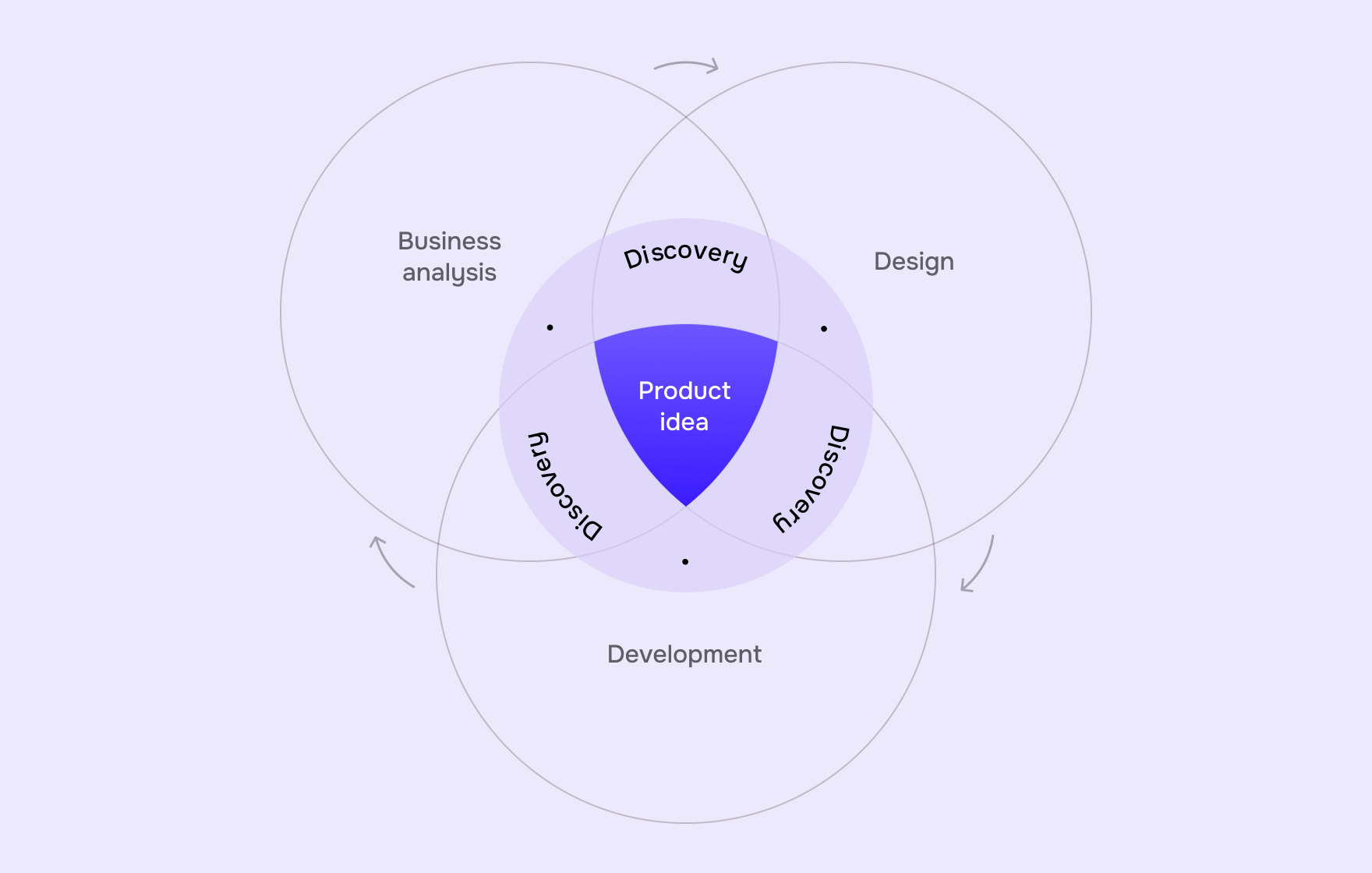
Creating a new product is always a worrying time: you've got to map out every phase and lay a solid foundation for the project. The big where-to-start question — design, scouting, or defining the project vision — trips up plenty of companies. Each one leans into their approach, shaped by their past experiences and expertise.
In this article, we're gonna walk you through our take on shaping these processes and the moves to make after that initial step in project development.
Unpacking the basics: what is the discovery phase in software development?
The discovery phase in software development is the starting point of an IT project, where teams define business objectives, outline technical requirements, estimate timelines and budgets, and identify potential constraints before any execution begins.
In practice, this stage brings together product, design, and engineering teams to align on scope, user flows, technical approach, and possible risks. Instead of jumping straight into design or development, teams use the discovery of a software project to reduce uncertainty and make reasonable decisions.
Although it comes first, the IT discovery phase is one of the most critical stages of the entire project. It sets the foundation for everything that follows — much like laying the groundwork before building a house. The clarity achieved here directly impacts the efficiency and success of the later stages.
At this point, the project is explored from three key perspectives: business analysis, design, and development. This includes defining business goals, understanding user needs, shaping functional requirements, and preparing detailed specifications that guide the team moving forward.
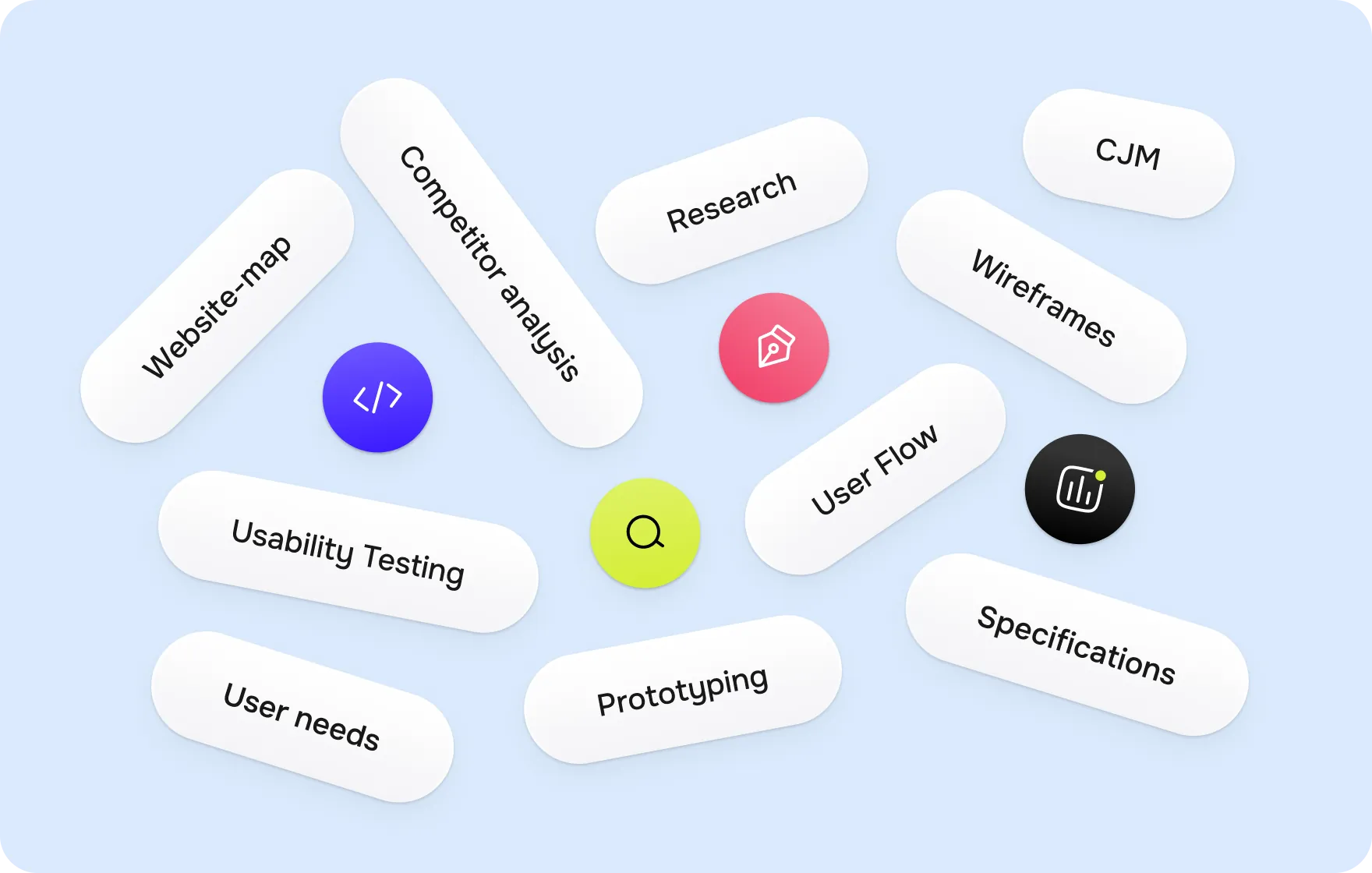
So, we write documentation and describe the project to understand what we'll do and how we’ll do it during the development stage.
The main goal of the IT discovery process is to define for the client all details that can be blurred in their requirements. We make it constant and clear. For example, if the client has a general idea of the needed functionality, we choose the specific features, how they would work, for whom, and at which stage. We learn it together with the client, come to a particular conclusion, and have a clear vision of what and how we will build. And finally, we then fix it in the documentation.
In the software development discovery phase, we dive deep to answer five key questions:
1. What major problems is this product tackling?
We get to know our target audience inside and out through business analysis and UX research. It's all about figuring out who we're designing for. A client might perfectly know his audience, but we come in to help pick the right visual tricks, schemes, and strategies to connect with people's needs cause we dive deep into the user experience.
2. What are the users’ pains and how can our product solve them?
Different audiences have different motives. Business-focused products often go for a more flat model, while creative ones can afford to be bolder and more expressive. We gather insights to grasp what our users expect and craft the product's functionality around these expectations. By the way, it is the basis of the Product Mindset — one of the main parts of Goodface’s philosophy.
3. What's going to be in the business solution?
Understanding what our audience is looking for lets us define the right features. Here we could help to shape everything that follows: the features that should be included, how they'll function, the product monetization strategy, and how we'll meet our audience's needs.
4. What's the product going to look like?
We conduct UX research. We get a clearer picture of people's expectations with user flows, customer journey maps, and user interviews. User stories give us a peek through the users' lenses at how the product functions. And wireframes? They're our blueprint for the project's structure and a sneak peek at the product's style.
5. What tech stack will we use and how to plan it properly?
Lastly, we learn the roots of clients’s expectations about technologies. Maybe a client wants basic features to quickly launch an MVP due to budget or time constraints. Or perhaps they're chasing the cutting edge, craving the latest tech to ensure their product outpaces the rest. Every desire leads us to specific choices in languages, technologies, servers, and strategies to achieve those goals.
As a result of the discovery stage, we have:
- The User needs that we will cover;
- The visual approach that we take;
- The tech strategy that's gonna meet our business objectives and resolve our audience's issues;
- The project's scope, cost, and timelines, all mapped out.
Unlocking the benefits of the software discovery process
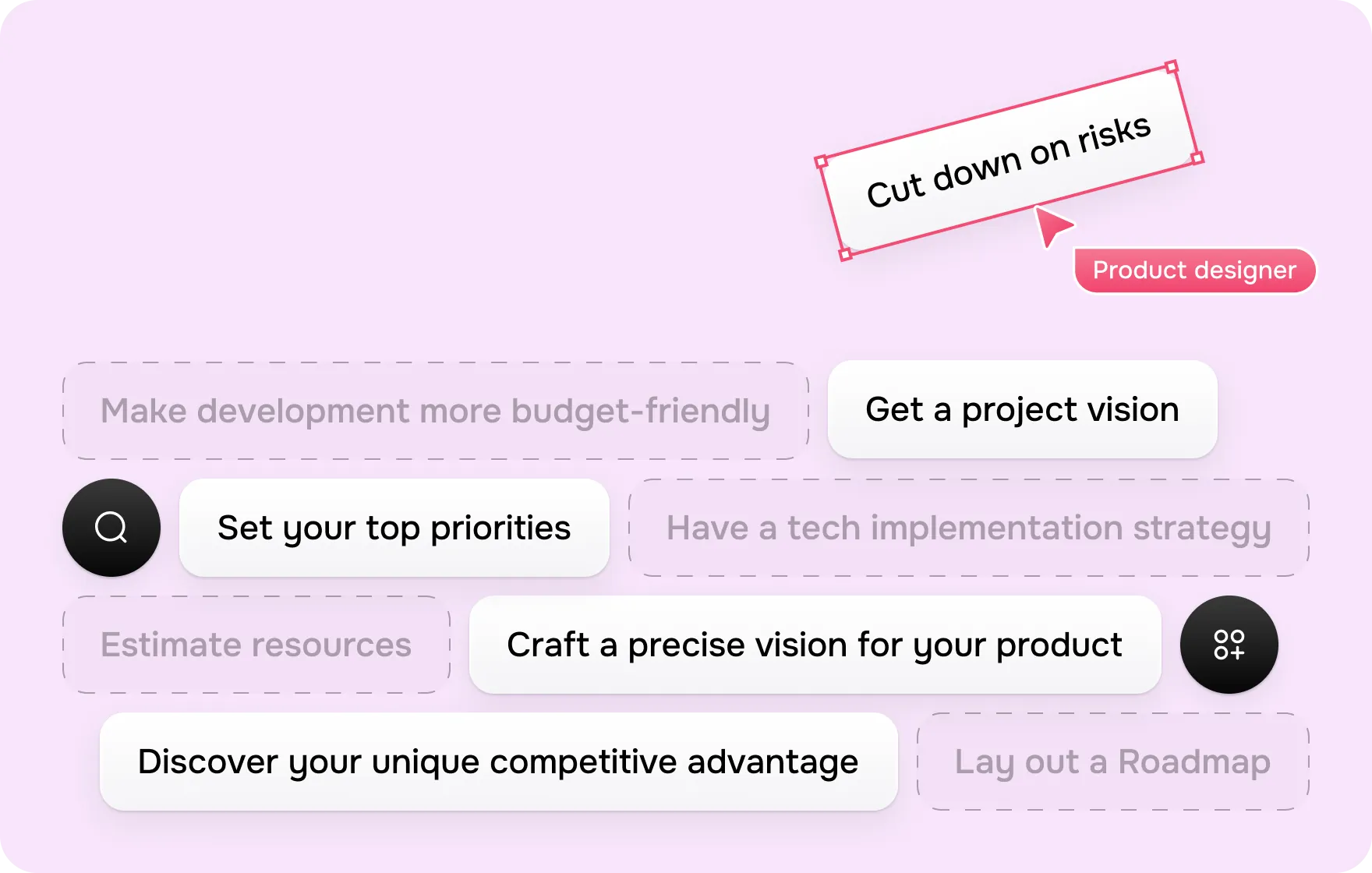
Many see the Product Development process as a combination of Design and Development stages. That's only part of the story. These two processes stand based on the Discovery stage, which lets us get the full scope of what's coming down the pipeline. It slashes risks and dodges delays, hiccups, and big blunders that could tank the whole project.
The project discovery phase is all about understanding and planning. The client can request some features and a budget. We evaluate the efficiency and calculate the cost of the needed features. If it doesn’t align with the client’s opportunities, we plan what should be included in the main scope and what can be postponed.
With the Discovery phase, you sidestep a heap of unnecessary design re-dos or heading down the wrong development path (like spending six months on a feature you don't need because the tech stack was off from the jump).
Nailing this milestone is like having a safety net for both the design and development teams and the client. It's a crucial step to map out the project, understand the ins and outs, and, most importantly, steer clear of most of the pitfalls or troubles.
Having the software project discovery phase behind your back, you probably would:
- Get a project vision
- Cut down on risks
- Estimate resources
- Set your top priorities
- Lay out a Roadmap
- Have a tech implementation strategy
- Make development more budget-friendly
- Discover your unique competitive advantage
How to conduct a discovery phase for an IT software project
The discovery phase is not just a sequence of steps — it’s a structured process that helps teams move from an initial idea to a validated product direction. Each stage builds on the previous one, gradually reducing uncertainty and shaping a clear execution plan.
Step 1: Define objectives and scope
The process starts with assembling the core discovery team. Typically, this includes a project manager, a UX/UI designer, a technical lead, and a business analyst — bringing together product, design, and engineering perspectives.
From there, the focus shifts to clarity:
- identifying key stakeholders (product owners, investors, end users)
- aligning with business goals and success criteria
- outlining initial assumptions and constraints
At this stage, the goal is not to finalize everything, but to establish a shared understanding of what the product is meant to achieve.
Step 2: Gather and analyse insights
Once the direction is defined, the team validates it through research. This step turns assumptions into informed decisions and typically covers three areas:
User research
Understanding user needs, expectations, and behaviours through interviews or existing data. This helps ensure the product solves a real problem.
Market research
Assessing demand, trends, and market conditions to identify opportunities and realistic positioning.
Competitor analysis
Reviewing similar products to understand feature benchmarks, strengths, weaknesses, and gaps in the market. Together, these insights shape product decisions and help avoid building on guesswork.
Step 3: Align with stakeholders
After the research phase, findings are consolidated and presented to stakeholders.
The focus here is on:
- validating assumptions
- highlighting risks and constraints
- refining priorities and scope
This step ensures that everyone is aligned before moving further, reducing the risk of misunderstandings later in the process.
Step 4: Define budget and timeline
With a clearer scope and validated direction, the team can now estimate:
- delivery timelines and key milestones,
- budget ranges and resource allocation
- potential risks or bottlenecks
Rather than rough guesses, these estimates are grounded in real data gathered during discovery, making them significantly more reliable.
Step 5: Build the roadmap
The final step is turning all insights into a structured execution plan:
- a prioritized feature roadmap
- defined deliverables and phases
- dependencies between design, development, and release
The roadmap becomes the bridge between discovery and execution. While it provides clear direction, it should remain flexible — allowing teams to adapt as new insights emerge during the project.
How does it work: The team behind the discovery phase
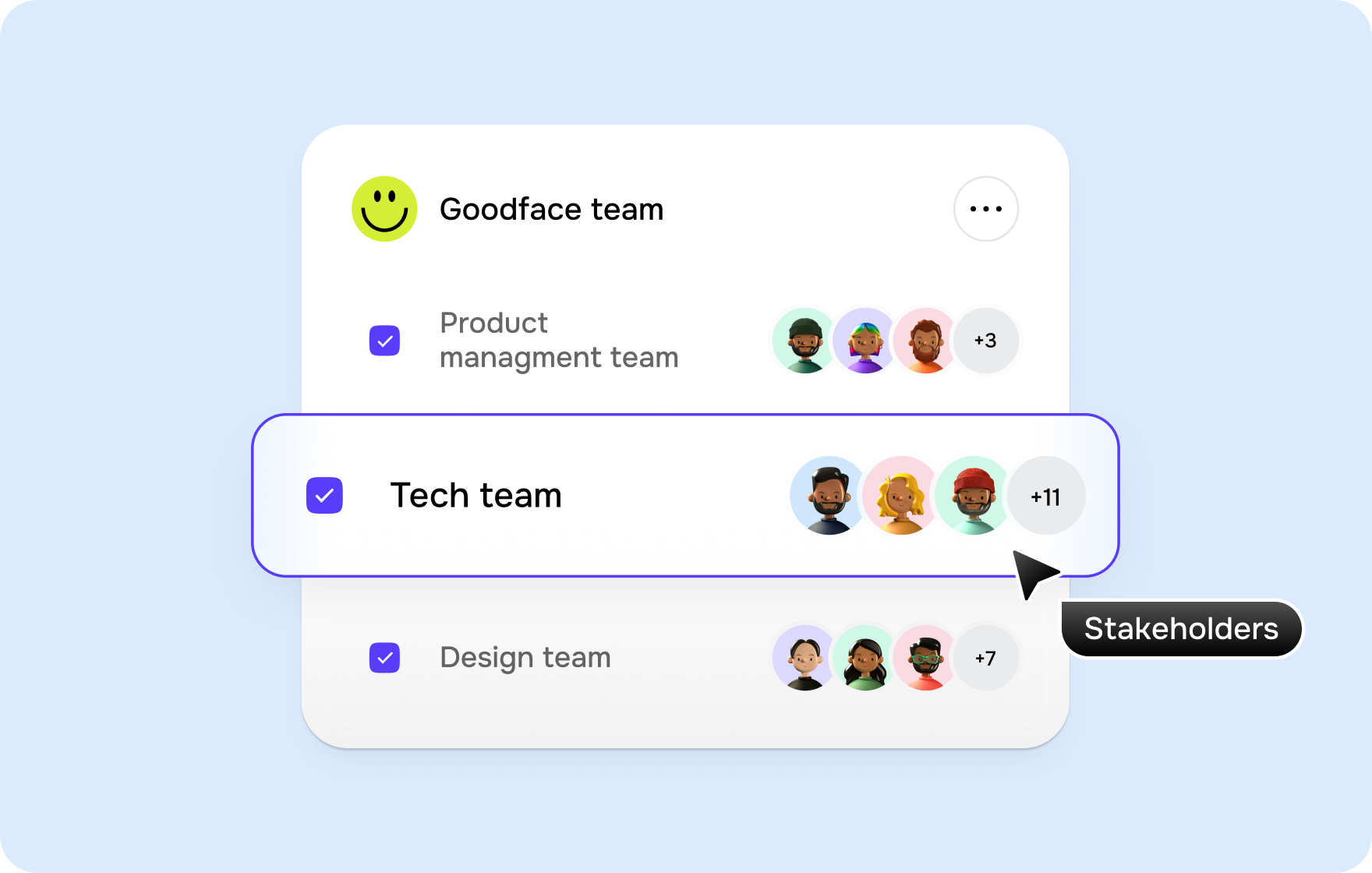
Stakeholders and domain experts
The discovery phase kicks off with them. The main drivers here are the product owner and visionary. They share an idea and a business model: how the project will work, what user problems it will solve, and why and how people will want to pay for it. It’s about the value of the product.
Design team: Lead designers and UX experts
Product designers play a crucial role in analyzing competitors, investigating the audience, crafting design concepts, keeping the user experience in mind, and also taking care of the aesthetics side. A deep understanding of user needs connects here with closely aligning the client's expectations.
Tech team: Tech lead, senior engineers and architects, CTO
The tech team is all about strategizing and forecasting. They dive into details, like how many people are going to use the product, what platforms it's going to live on, and how it'll operate. Next up, they're choosing the perfect frameworks, solutions, and tech stack. Getting this stuff right from the get-go is crucial because if something's off, your developers might have to backtrack and redo work, which is a situation we all want to avoid.
Product management team: Business analysts, product managers, and delivery managers
BA is in charge of market research and understanding project objectives. PM or delivery manager orchestrates seamless collaboration among all team members, ensuring alignment on requirements and project vision. This team gives a plan and a crystal-clear roadmap for the client, so they know exactly what's happening with the project and what to expect in the coming month.
Stages of discovery
The scope of the discovery process depends on the size and complexity of the project, but our classic Discovery routine includes such steps:
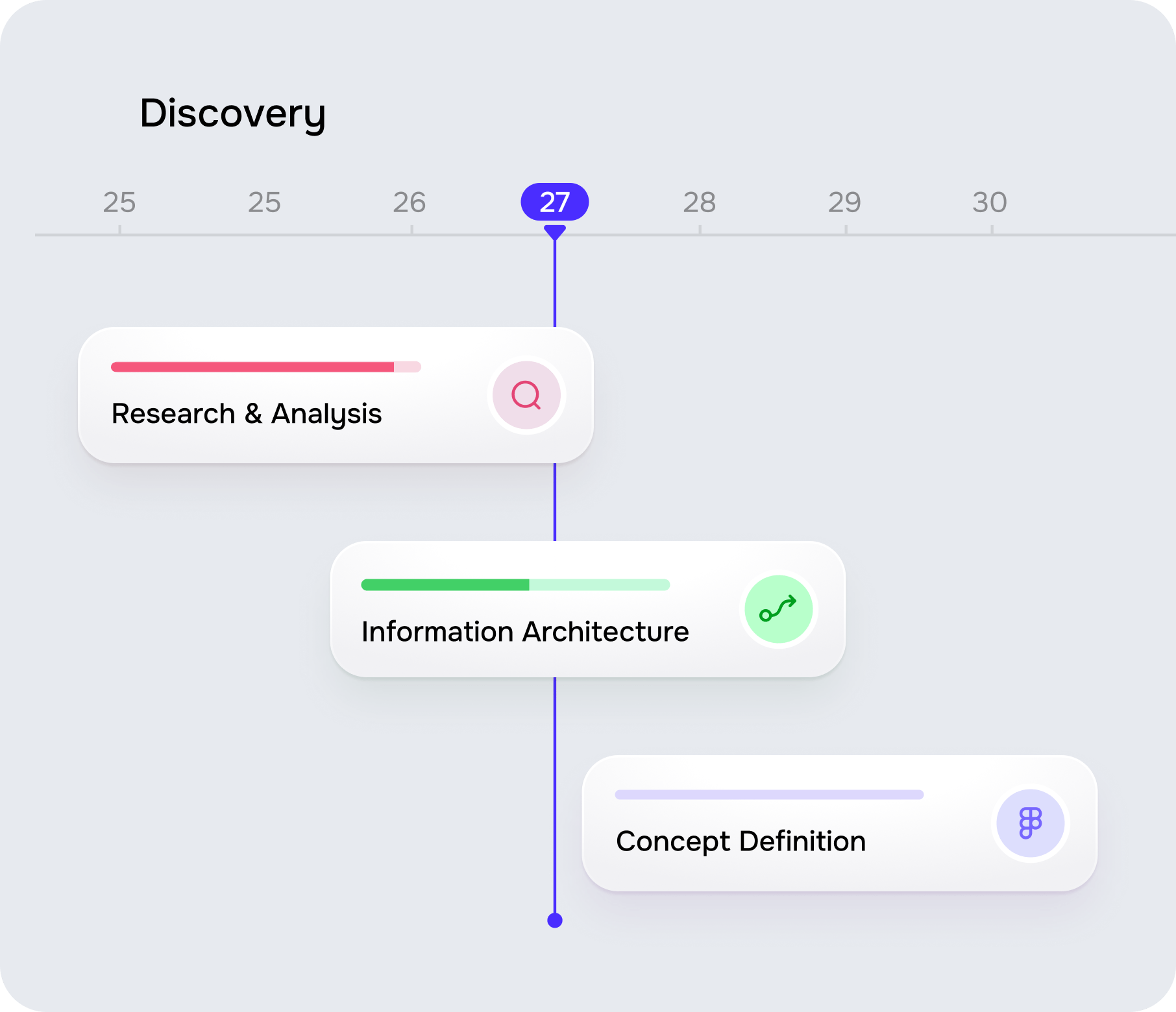
1. Collection of information
- Stakeholder interviews
- Market analysis
- Сompetitor research
2. UX research
- User interviews / User stories
- CJM / User flow
- Wireframes / Prototypes
3. Specification
- Tech stack
- Feature set and description
- Obligations and requirements
4. Project estimation
Collection of information
Stakeholder interviews
Here we turn requirements into plans. We learn business ideas through interviews with clients and other stakeholders. It's just the starting point, so we aim to get beneath the surface of the future product's concept. The primary objective of this stage is to grasp our client's expectations and objectives and gather insights about their audience, competitors, and existing infrastructure. Together it allows us to paint a comprehensive picture of the business idea at hand, envisioning the scale and form of the future software.
Market analysis
Data collection is at the core of what we do across all departments — the backbone of our discovery process. Understanding the nuances of the market is crucial because every industry has its own unique set of rules. But the market is always evolving, so we make it a point to dive deep into research at the start of every project. It's our chance to stay on top of the latest trends and tendencies and build a road map based on what's happening.
Сompetitor research
At this stage, we must determine the level of competitiveness of the market, and figure out its major players. By studying other companies, we can spot common patterns, learn from their wins and losses, and draw inspiration from their innovations.
We take into account and use advantages and rid of vulnerabilities.
Competitor analysis also helps us fine-tune our strategy by showing us where we can make improvements. After all, the market mirrors what the audience wants.
UX research
CJM / User flow
To ace the architecture, you gotta start with the basics. That means diving deep into UX research. The first step? Crafting a customer journey map. It helps to define the dependencies of functions, and role management and gives us a visual roadmap of what needs to get done.
User interviews
User interviews are a super handy tool for digging deep into what users want, expect, encounter as problems, feel as pain points, and prefer. It's like a direct line to uncovering solutions that genuinely resonate with real humans. For us, it’s also an awesome opportunity to get on the same wavelength as our users and see the world from their perspective.
Wireframes / Prototypes
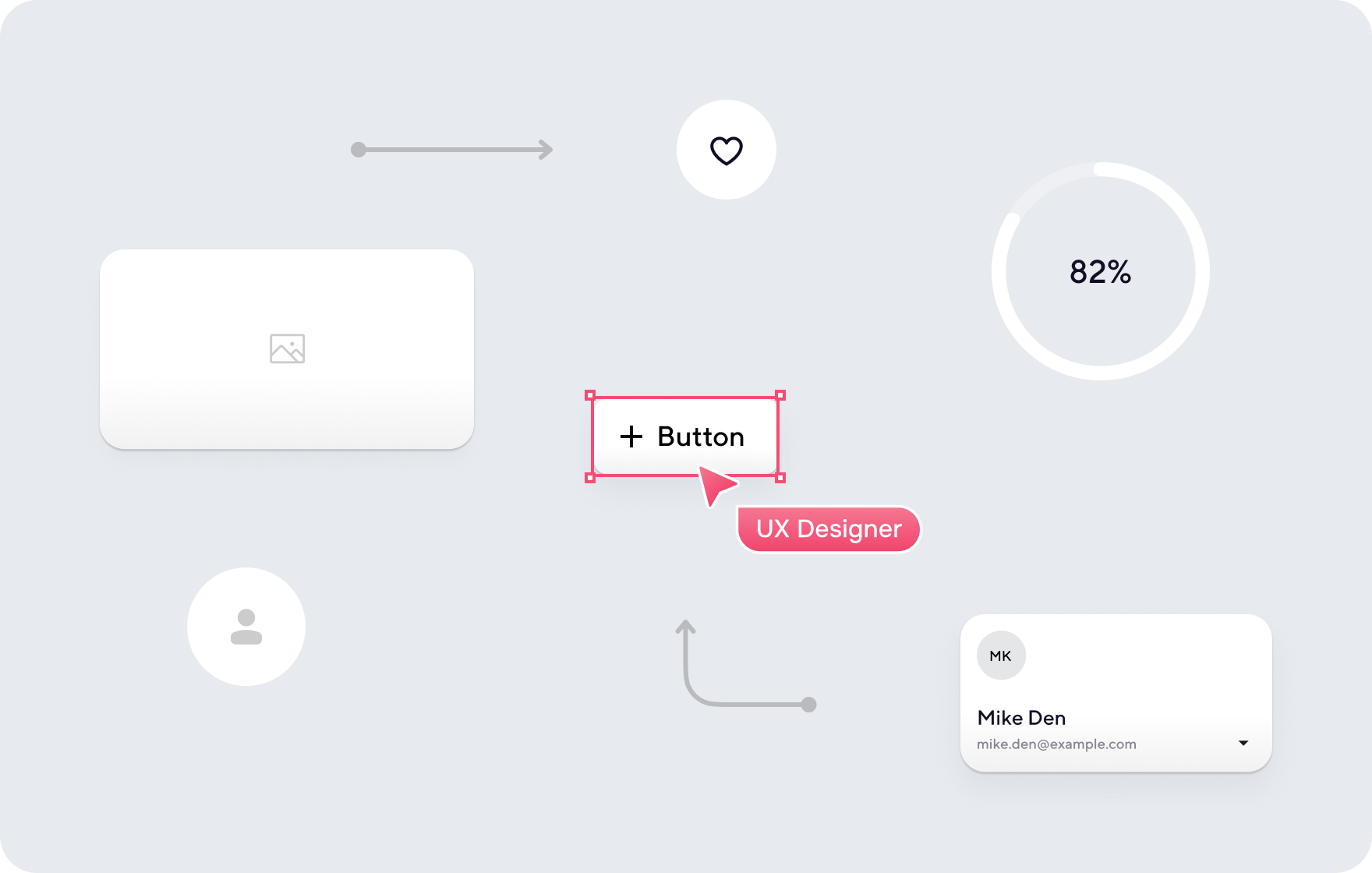
Then UX research slowly flows into the design phase. But before that step client has a quite wide window of opportunity. The timeframe largely depends on the project's terms and complexity. During this period, we can swiftly develop a series of wireframes outlining detailed user flows and system functionality. This phase is all about establishing structure but also allows us to outline the visual components, refine the functional requirements of the product, and segment the project into manageable release stages.
Furthermore, we can even take it a step further by creating a clickable prototype and design concepts during this phase.
Specification
Next up, we hit the specification phase, where we polish, document, and record the requirements.
Tech stack
Every project calls for its own set of tech tools. This is where our developers break down the tech necessities for each solution, covering programming languages, frameworks, databases, deployment environments, and more.
Features description
This part is all about detailing what the final product will be able to do. We're mapping out user features, admin capabilities, integrations with other systems, etc.
Obligations and requirements
At this step, we must define some requirements for the developing product, like safety, scalability, productivity, compatibility, and other key factors.
Now, let's explore the impact of the discovery stage on the project
Let's dive into two hypothetical cases: one in design and the other in development.
Development case
Imagine we're tasked with creating a custom software solution. Let's explore how things might unfold.
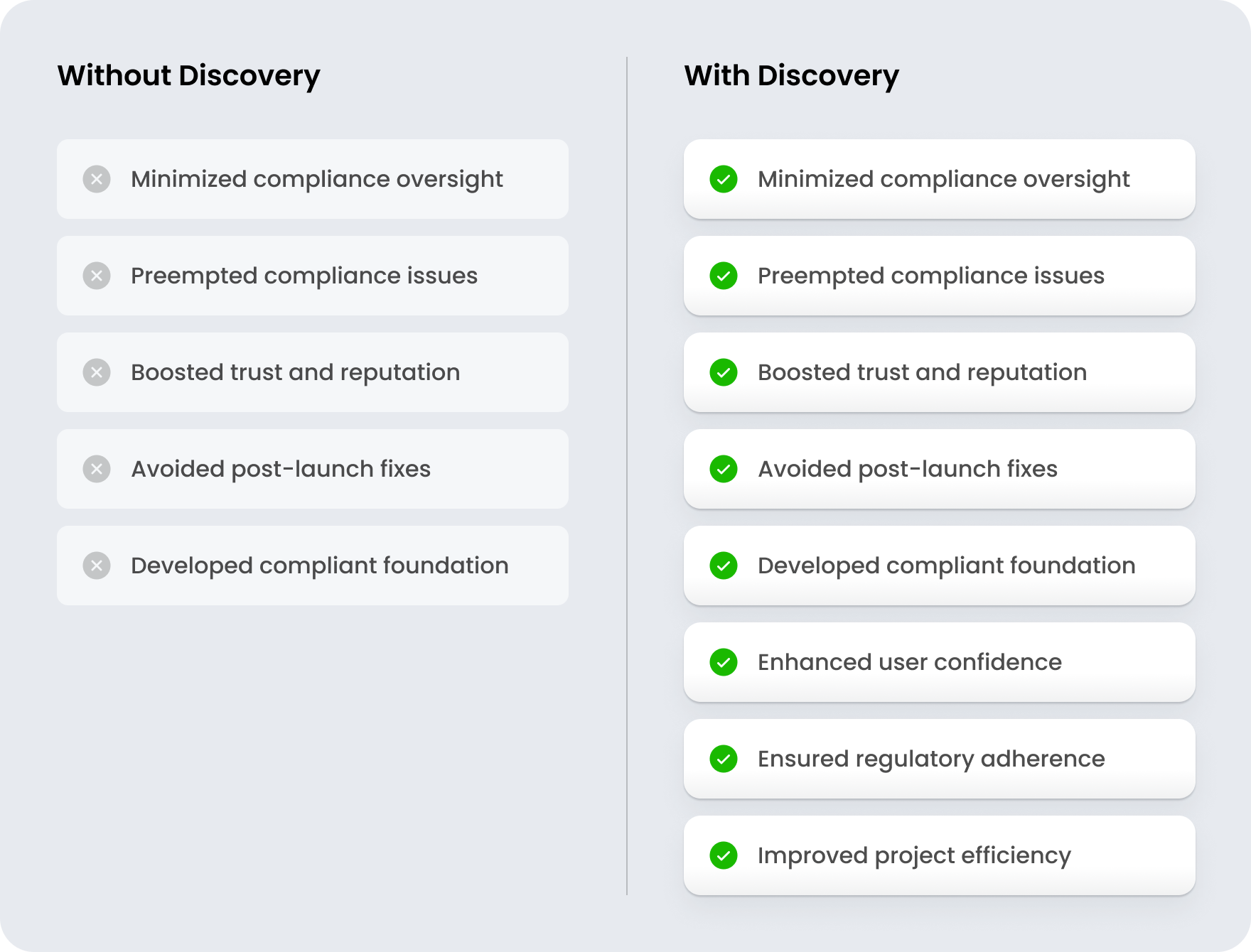
Without discovery
Risks
Overlooking critical compliance and data security requirements for the project's industry. The development team decides on a technology stack that only partially supports needed compliance, thinking it's more cost-effective.
Issues
Shortly after launch, it becomes apparent that the software doesn't meet industry-specific compliance standards, putting the business at risk of violating privacy laws and facing penalties.
Result
The software requires significant backend rework to meet compliance standards, disrupting business operations. This oversight increases project costs substantially and damages the trust between the company and users of the product.
With discovery
Risks
The likelihood of overlooking compliance and security needs is minimized. Discovery insights ensure the selection of a technology stack that supports needed compliance and robust data security from the get-go.
Issues
By conducting thorough compliance checks and stakeholder interviews during the Discovery phase, the team aligns the software development with industry standards, preempting any compliance issues.
Result
The software is developed with compliance and security of foundational elements, meeting the business's needs and regulatory requirements. This alignment boosts users' trust, enhances the company's reputation, and avoids the financial and time costs of post-launch fixes.
Design case
Picture this: we're developing a web platform for a firm. Let's run through a couple of scenarios.
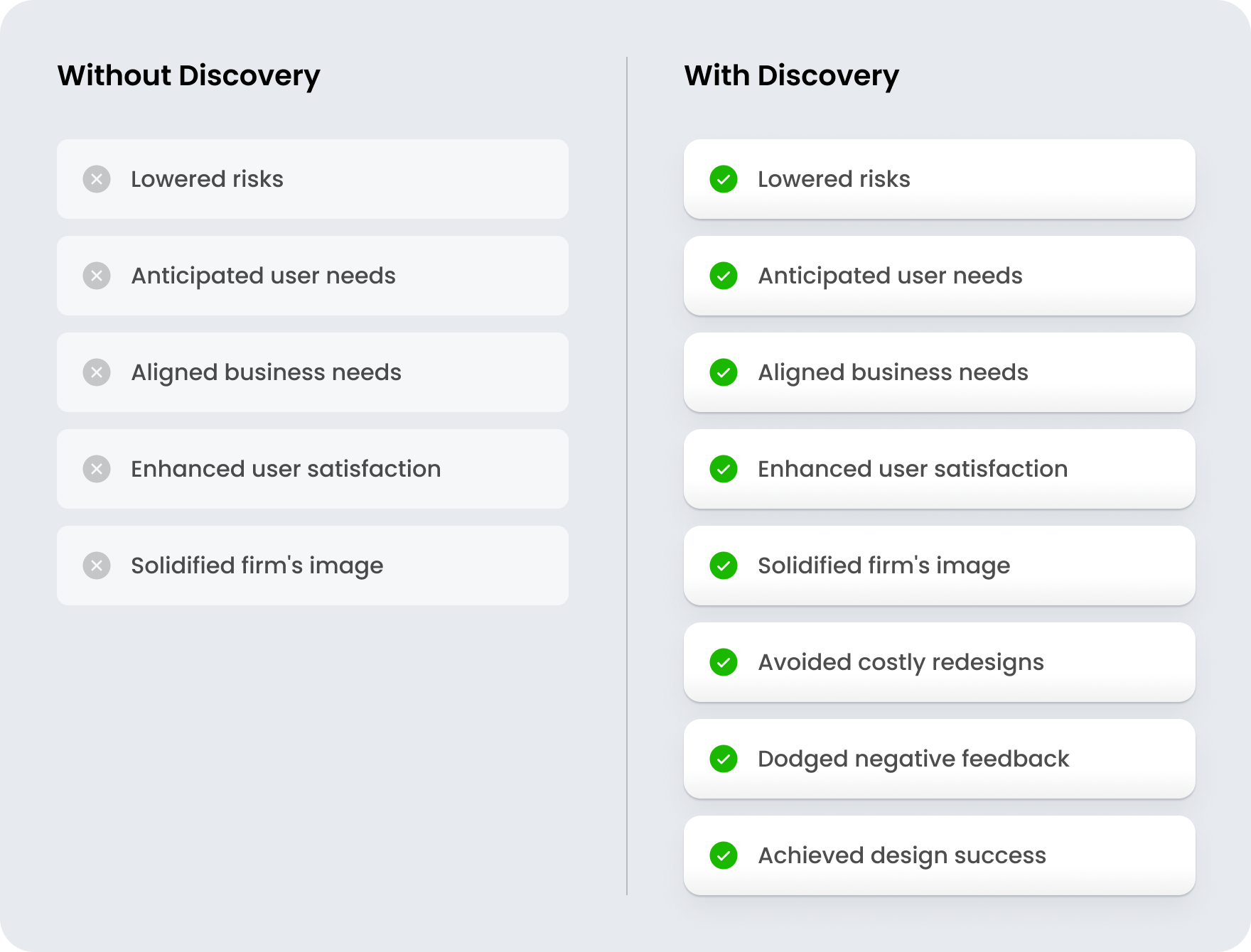
Without discovery
Risks
The lack of understanding of the client's audience. The team went for a bold, playful design, assuming it would make the platform stand out.
Issues
Upon launch, feedback shows that the vibrant design didn't sit well with the firm's clients, who prefer professionalism over playfulness.
Result
The platform's design misses the mark for user expectations, getting down the firm's professional image. This mismatch could even cost them clients and lead to pricey redesigns.
With discovery
Risks
The chances of running into big trouble are way lower. With insights from the Discovery phase, the Design and Development teams will aim for a more subdued style and the right features that line up with industry norms.
Issues
Due to user interviews and market research, we got ahead of what users were expecting, avoiding not meeting audience needs and, therefore, dodging negative feedback.
Result
The business needs are aligned with user expectations, so the Design and Development efforts hit their targets, enhancing user satisfaction, solidifying the firm's pro image, and steering clear and avoiding costly redesigns.
Summary
The discovery phase of a software project is the ground part of the project. It’s a serious process, that needs evolving experts from various fields: business analysis, design, and development. We advise you not to skip it; it’ll save a lot of money and time.
FAQ
Do you need a discovery phase for an MVP?
Even for an MVP, a software discovery process is important.
While the scope may be smaller, teams still need to:
- define core features
- prioritise functionality
- validate technical feasibility
A shorter software development discovery phase helps ensure the MVP solves a real problem and can be built within realistic constraints.
Can we skip the software discovery phase?
Technically — yes. However, in practice, we strongly advise against it because skipping the discovery phase in software development projects often leads to unclear scope, constant adjustments during development, and increased overall costs.
Teams that move straight into the dev stage usually spend more time fixing decisions later than they would have spent defining them upfront.
Here are the most common risks teams face when ignoring the software discovery process:
1. Unclear scope and constant changes
Without a defined project discovery phase, requirements remain vague. As development progresses, teams keep revisiting decisions, which leads to scope creep and delays.
2. Incorrect technical decisions
When the software development discovery phase is absent, architecture and tech stack choices are made too early. This can result in limitations, rework, or systems that don’t support future growth.
3. Misalignment between teams
Product, design, and engineering may interpret requirements differently. Without a shared foundation created during the discovery phase of a software project, this leads to inconsistent decisions and rework.
4. Underestimated timelines and budget
Without a proper IT discovery process, estimates are based on assumptions rather than the real scope. Software design and development projects often take longer and cost more than expected.
5. Poor user experience
Skipping UX research and flow definition leads to products that are harder to use. Fixing UX issues after development is significantly more expensive than addressing them during the software discovery process.
6. Compliance and risk gaps
In fintech, health tech, and other regulated industries, missing requirements during the discovery phase of a project can lead to compliance issues, security gaps, and legal risks.
7. Higher long-term costs
What looks like a faster start often results in more rework, redesign, and redevelopment later. The cost of skipping the discovery phase service for a software project is usually paid during development or after launch.
Why does the discovery phase matter for an IT project?
The discovery phase of a software project sets the foundation for everything that follows — from product decisions to delivery pace.
It helps teams:
- define product direction and priorities
- identify risks and constraints early
- align stakeholders on scope and expectations
- plan realistic timelines and budgets
Without a structured discovery phase, teams often move forward with assumptions rather than confirmations, which causes delays, rework, and inconsistent execution.
When do you need a software discovery phase service?
You need a discovery phase service for a software project when key product decisions are still undefined or unvalidated.
Typical scenarios include:
- The initial product idea is still rough and needs structure
- Requirements are incomplete, outdated, or not documented
- You’re planning to scale, redesign, or extend an existing product
- Multiple stakeholders are involved and need alignment before execution
- The team needs reliable scope, timeline, and budget estimates before development
A structured software discovery process helps turn assumptions into clear decisions, so design and development can move forward without constant rework.
Can the discovery phase change the initial product idea?
Yes — and that’s often the point. During the IT discovery phase, you test initial hypotheses against user needs, technical constraints, and market context.
This can help refine or even rethink parts of the product before investing significant resources.
Making these changes early is significantly less costly than adjusting direction during development.
What’s the difference between discovery process and planning?
The discovery phase in software development focuses on defining what to build and why. Planning, on the other hand, focuses on how to deliver it — breaking down tasks, assigning resources, and organising execution. Discovery reduces uncertainty. Planning organizes delivery based on that clarity.
Read more
 advantage
 Book a call
Fill out the form
or brief with questions



 LinkedIn
 Instagram
Welcome to Goodface privacy notice.
Goodface respects your privacy and is committed to protecting your personal data. This privacy notice will inform you as to how we look after your personal data when you visit our website (regardless of where you visit it from) and other sites we own and operate. And tell you about your privacy rights and how the law protects you.
We may change the privacy policy from time to time to reflect changes to the products and services that we provide and how we process your personal data.
We will not share your information with any third party outside of our organization, other than as necessary to fulfil your request if any."
INFORMATION WE COLLECTWhen you visit our website, our servers may automatically log the standard data provided by your web browser. This data is considered “non-identifying information”, as it does not personally identify you on its own. It may include:
- Your computer’s Internet Protocol (IP) address;
- Your browser type and version;
- The pages you visit;
- The time and date of your visi;
- The time spent on each page;
We may ask for personal information, such as your name and email address. This data is considered “identifying information”, as it can personally identify you. We only request personal information relevant to providing you with a service, and only use it to help provide or improve this service.
We collect information by fair and lawful means, with your knowledge and consent. We also let you know why we’re collecting it and how it will be used. You are free to refuse our request for this information, with the understanding that we may be unable to provide you with some of your desired services without it.
We will only process personal data and communicate with you if:
1. You have given us consent to the processing of your personal data and communicating for one or more specific purposes i.e. requesting products or services from us, downloading material or information from our website or submitting a contact us form.
2. Performance of a contract
3. Where we have a legitimate interest for contacting you in relation to our products and services
DATA PROCESSING AND STORAGEWe only retain personal information for as long as necessary to provide a service, or to improve our services in future. While we retain this data, we will protect it within commercially acceptable means to prevent loss and theft, as well as unauthorised access, disclosure, copying, use or modification. That said, we advise that no method of electronic transmission or storage is 100% secure, and cannot guarantee absolute data security.
Rights and choices of individuals:
- See what data we have about you, if any;
- Change/correct any data we have about you;
- Have us delete any data we have about you;
- See what security measures we apply to your data;
- Express any concern you have about our use of your data;
You may opt out of any future contacts from us at any time. You can do the following at any time by contacting us via the email address given on our website: goodface.agency
Got questions or want to discuss a project?


