

Why AI-orchestrated product development is replacing AI-native teams and traditional outsourcing



TL;DR
AI-native development and traditional outsourcing still rely on fragmented execution — humans or tools generate work, but coordination, validation, and delivery remain manual, slow, and error-prone.
AI-orchestrated development outperforms both by restructuring software delivery into a controlled system of parallel, AI-driven execution with continuous human validation.
Instead of managing developers or correcting AI outputs, you define product intent and constraints — while AI orchestration handles execution, consistency, and end-to-end delivery.


AI orchestration in product development | 01:49 min
No time to read? Explore through headphones, speakers, or on the go.
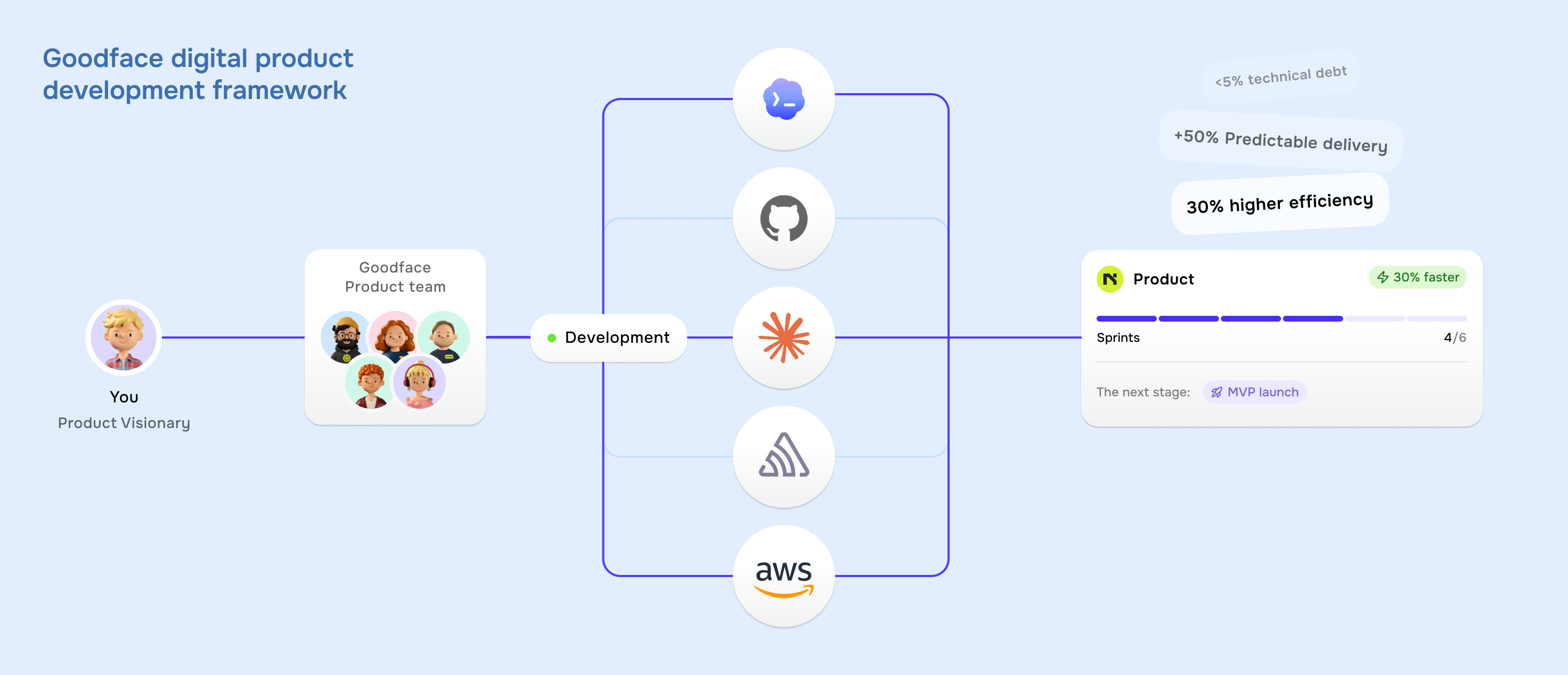
Goodface digital product development AI-orchestrated framework
AI has accelerated software generation faster than software delivery itself. We now operate in a structural imbalance: building software is faster than ever, while shipping reliable products has become more fragile.
This imbalance doesn’t just slow teams down — it makes delivery fundamentally harder to control.
- code ≠ product
- generation ≠ integration
- speed ≠ delivery
AI optimizes for local output, but product delivery is a system-level coordination problem. Teams can now generate code, prototypes, and even full modules in minutes. But once this output enters real environments, the main bottlenecks become decision validation, integration, deployment, and fragmented responsibility.
Why AI-powered development breaks without AI orchestration?
To understand why this happens, you need to look at how product delivery actually works.
Any project always operates across four core layers:
- ideation — where AI processes the initial request
- generation — where AI creates outputs
- validation — where teams verify quality and correctness
- execution — where systems get integrated and shipped
AI dramatically accelerates generation, but validation and execution still depend on human decisions, structured processes, and system constraints.
Without AI orchestration, AI tools behave like disconnected accelerators: each improves isolated tasks, but increases downstream bottlenecks:
- Costs grow unpredictably due to rework and coordination overhead
- Output quality becomes inconsistent across the system.
- Decision ownership fragments across tools, teams, and stakeholders
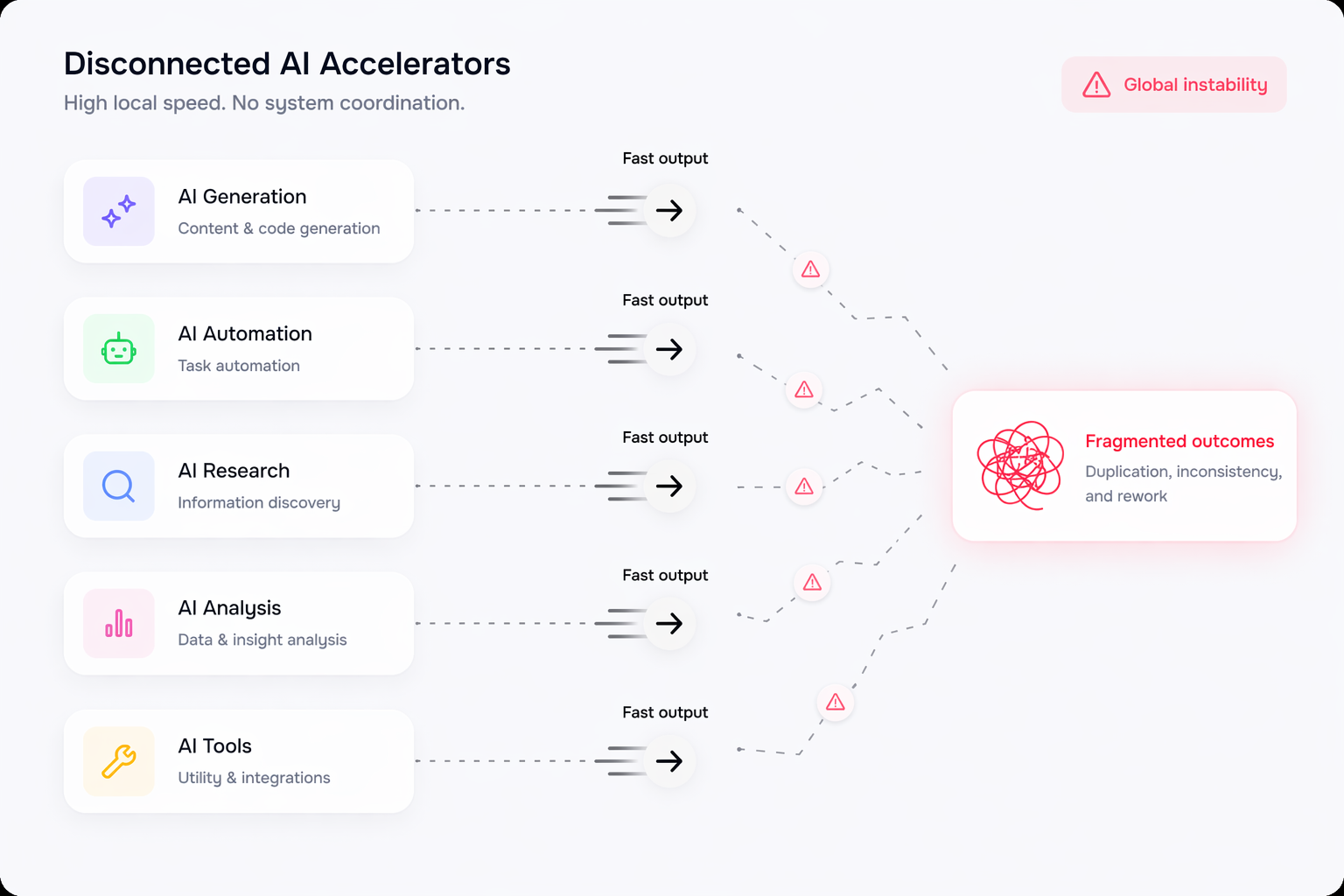
How only AI acceleration leads to fragmented outcomes and rework
What product development teams actually experience (but rarely say publicly)
There is a lot of frustration across Reddit and engineering communities:
- “AI works in demos, but breaks in production.”
- “Costs scale unpredictably due to retries and loops.”
- “Outputs look correct, but fail under real conditions.”
- “Teams spend more time fixing than building.”
- “Clients become de facto project managers.”
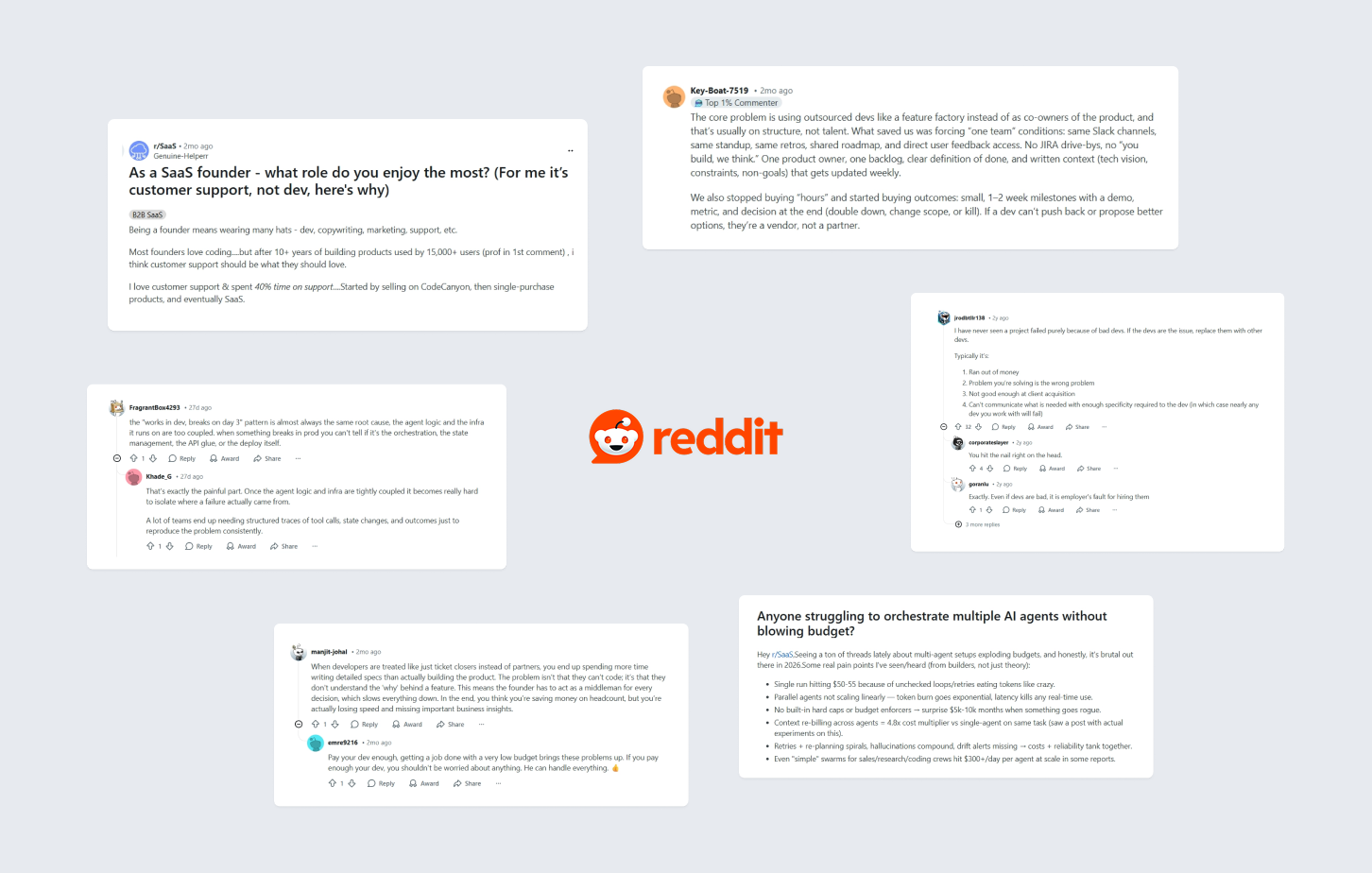
Reddit threads about AI development bottlenecks
What is AI orchestration? (beyond the buzzword)
In most guides and articles, AI orchestration in product development is described as the coordination of multiple AI systems, tools, workflows, and humans into a unified execution system that delivers complex outcomes.
However, in real product teams, it means a clear transition from tool-centric to human-owned framework:
AI orchestration is a decision-routing and validation design system that determines when AI acts, humans intervene, and how the project moves from idea to production without slowing delivery or involving founders.
AI Orchestration doesn’t replace your SDLC — it upgrades how it works
AI orchestration is designed to accelerate the Software Development Lifecycle while improving consistency, quality, and predictability of outcomes.
The classic SDLC follows a sequential loop — from requirements to release — where each phase depends on the previous one. This creates delays, late feedback, and costly rework. In most teams, a full iteration cycle typically takes one sprint.
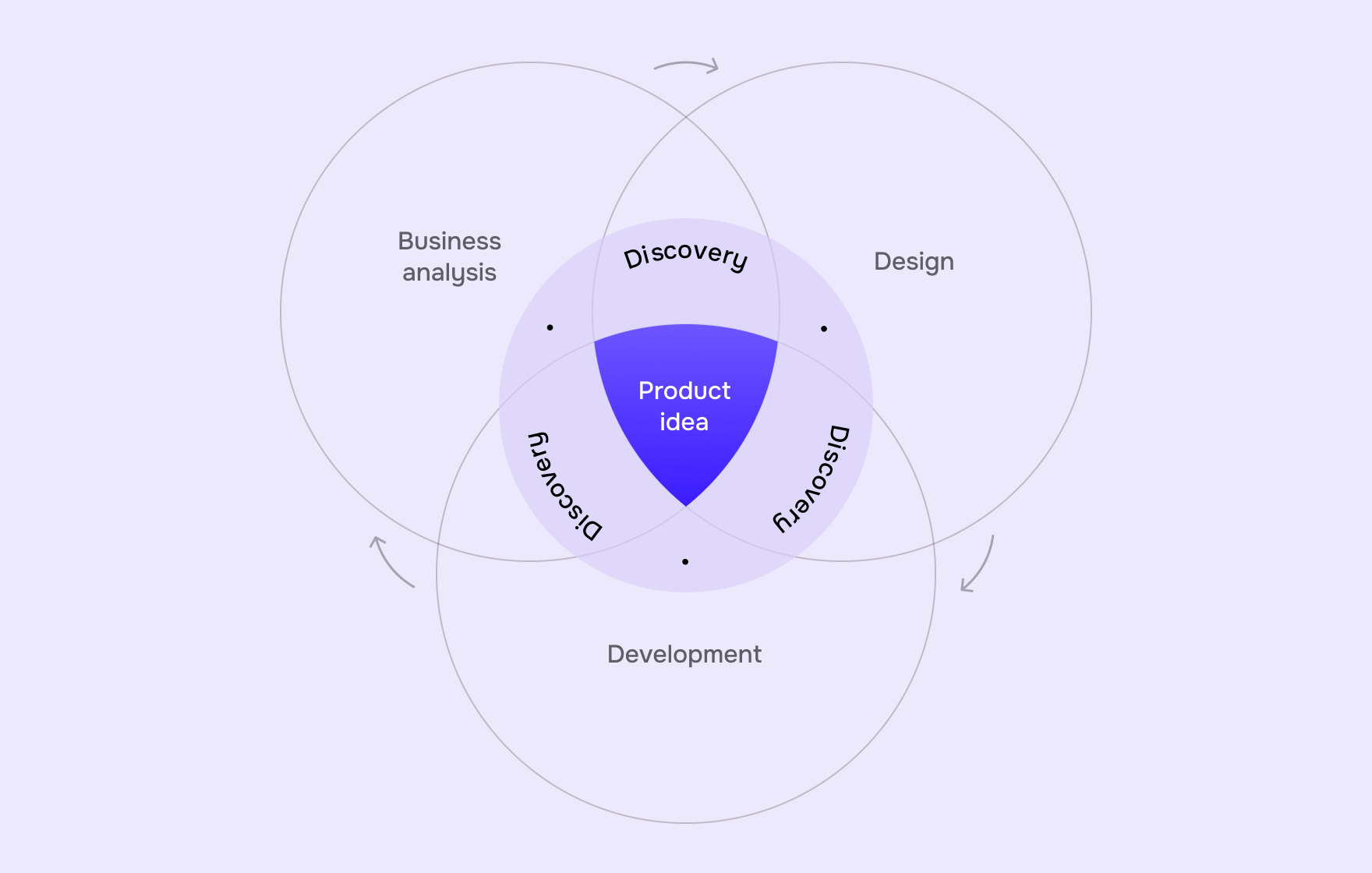
Our product development framework changes how this process runs. Instead of moving step by step, we decompose work into parallel streams, with AI handling routine execution and humans focusing on decisions and system design. Multiple parts of the lifecycle advance simultaneously, with validation occurring continuously rather than at the end.
As a result, iteration cycles become multiple times shorter, while quality remains stable — and often improves due to ongoing validation.
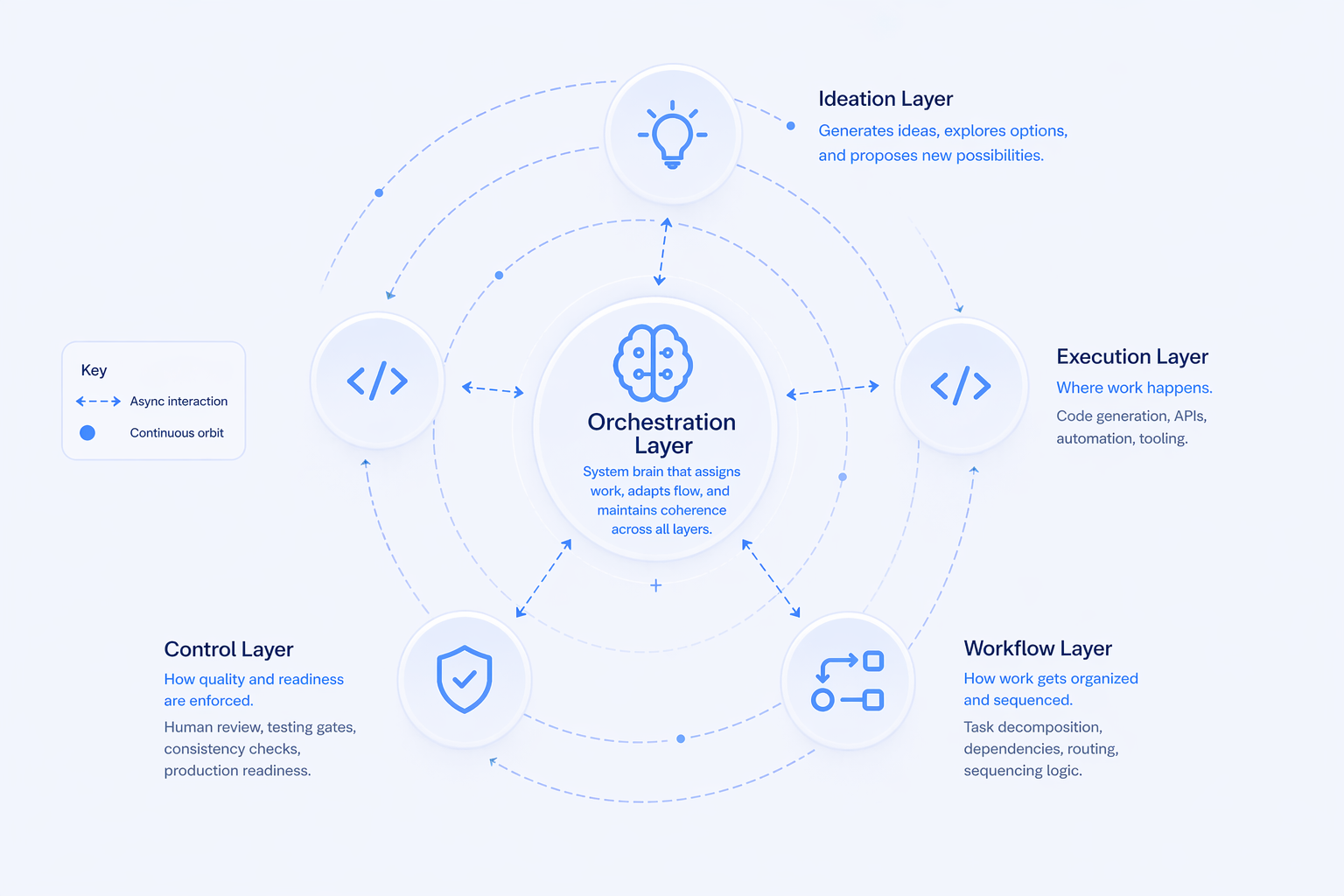
Async AI orchestration layers that interact with each other
We use a system of coordinated tools and workflows:
- AI-powered requirement structuring — turning raw inputs into clear, actionable scope
- Automated research & discovery — validating ideas, edge cases, and assumptions early
- AI-assisted UX/UI exploration — generating and iterating interface concepts faster
- Code generation & augmentation — accelerating development without sacrificing control
- Automated testing (functional & regression) — identifying issues continuously, not at the end
- System integration workflows — ensuring components work together from early stages
- Continuous feedback loops — insights are captured and applied in real time
How we use an AI-orchestrated framework in real delivery
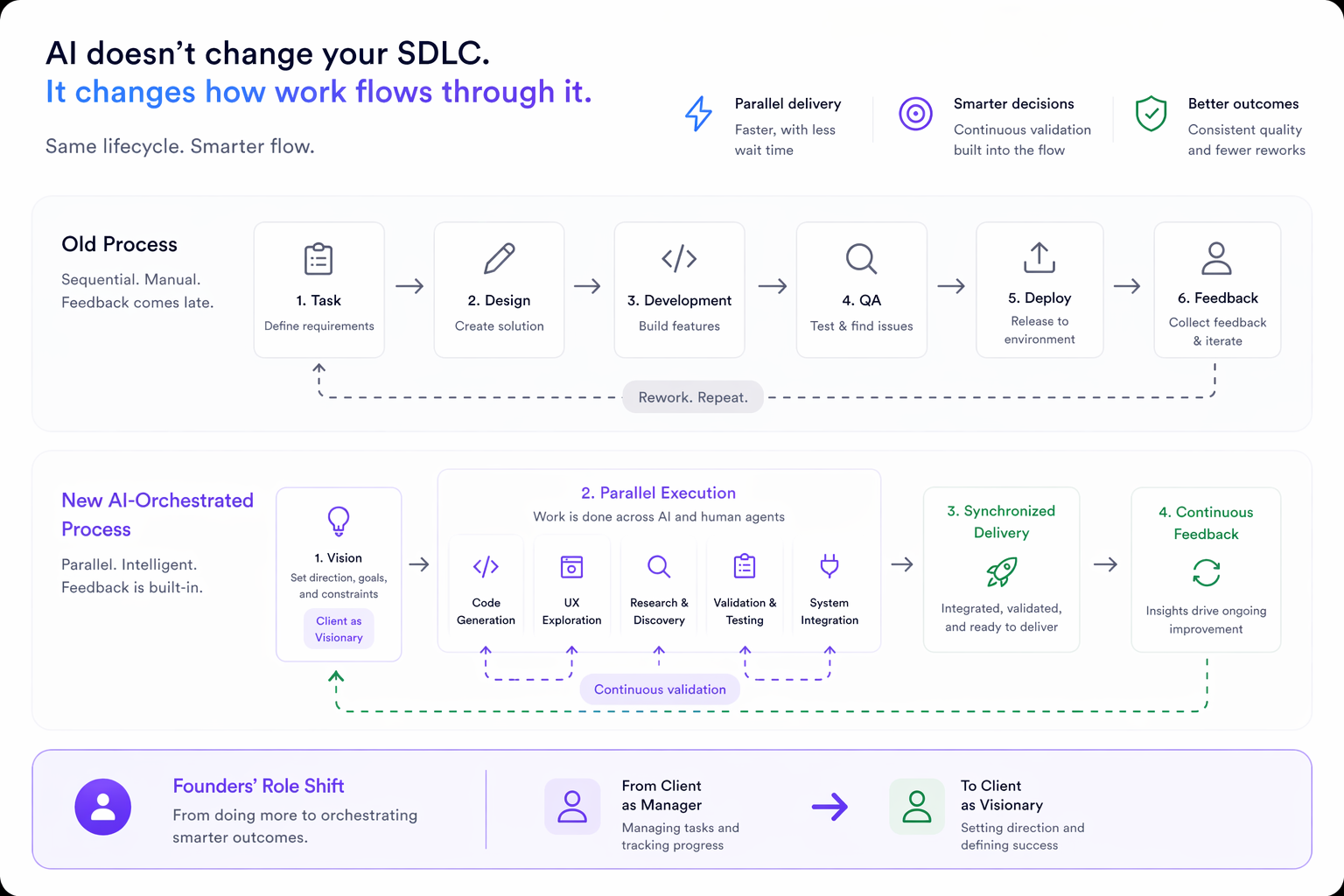
Goodface team's software development lifecycle compared to classic SDLC
Most explanations describe AI orchestration as a pipeline. In reality, it behaves more like a controlled loop between intent, execution, and validation.
Your product idea is a high-level intent for the entire system — for example, “build a fintech onboarding experience.” From there, it immediately breaks down into structured domains such as backend logic, compliance, user flow mapping, testing, and analytics. At this stage, orchestration makes a critical decision: how to distribute work across the system.
Some tasks are delegated to AI (typically those that are repetitive or pattern-based), such as drafting code and documentation, generating test cases, or producing research summaries. At the same time, humans remain responsible for architecture, design decisions, and trade-offs.
If you’re looking to build the product this way, we can translate your vision into an AI-orchestrated development.
Share your project idea and let’s discuss how to turn it into a working product.
This distribution isn’t random cause it has six clear milestones:
- Intent definition.
The client defines the business vision — not as a list of tasks, but as a direction the system must achieve.
- Task decomposition.
The team translates that intent into a structured system of work, covering architecture, UX, backend logic, QA, and documentation.
- Intelligent routing.
The system assigns each task based on its nature: AI handles routine execution, humans own decisions, and tools automate repeatable operations.
- Execution.
AI generates initial outputs, engineers refine and integrate them into the system, and automation reduces manual overhead wherever possible.
- Validation.
All outputs pass through testing, review, and consistency checks before anything moves forward — this enforces reliability.
- Feedback loop.
The system doesn’t just fix errors; it feeds them back into the workflow, improving outputs and refining the process over time.
Market reality: AI adoption is high,
but delivery quality isn’t
AI in product development is no longer experimental. McKinsey & Company 2024 industry research shows that most companies already use or actively explore AI in software delivery, but only a small share has integrated it into real production workflows.
At the same time, BCG teams report AI-enabled tools and agents are generating substantial productivity gains, frequently hitting the 20–40% range in engineering and tech tasks, while struggling to scale these improvements across entire systems.
This creates a structural gap. Organizations invest in AI and experiment with it, yet fail to translate these gains into predictable delivery outcomes. In many cases, AI adoption outpaces process redesign, making process redesign the real bottleneck.
As a result, companies move from pilots to broader AI operating models and even expect AI capabilities in delivery partnerships, but still lack consistent ROI at scale. AI moves faster than the systems around.
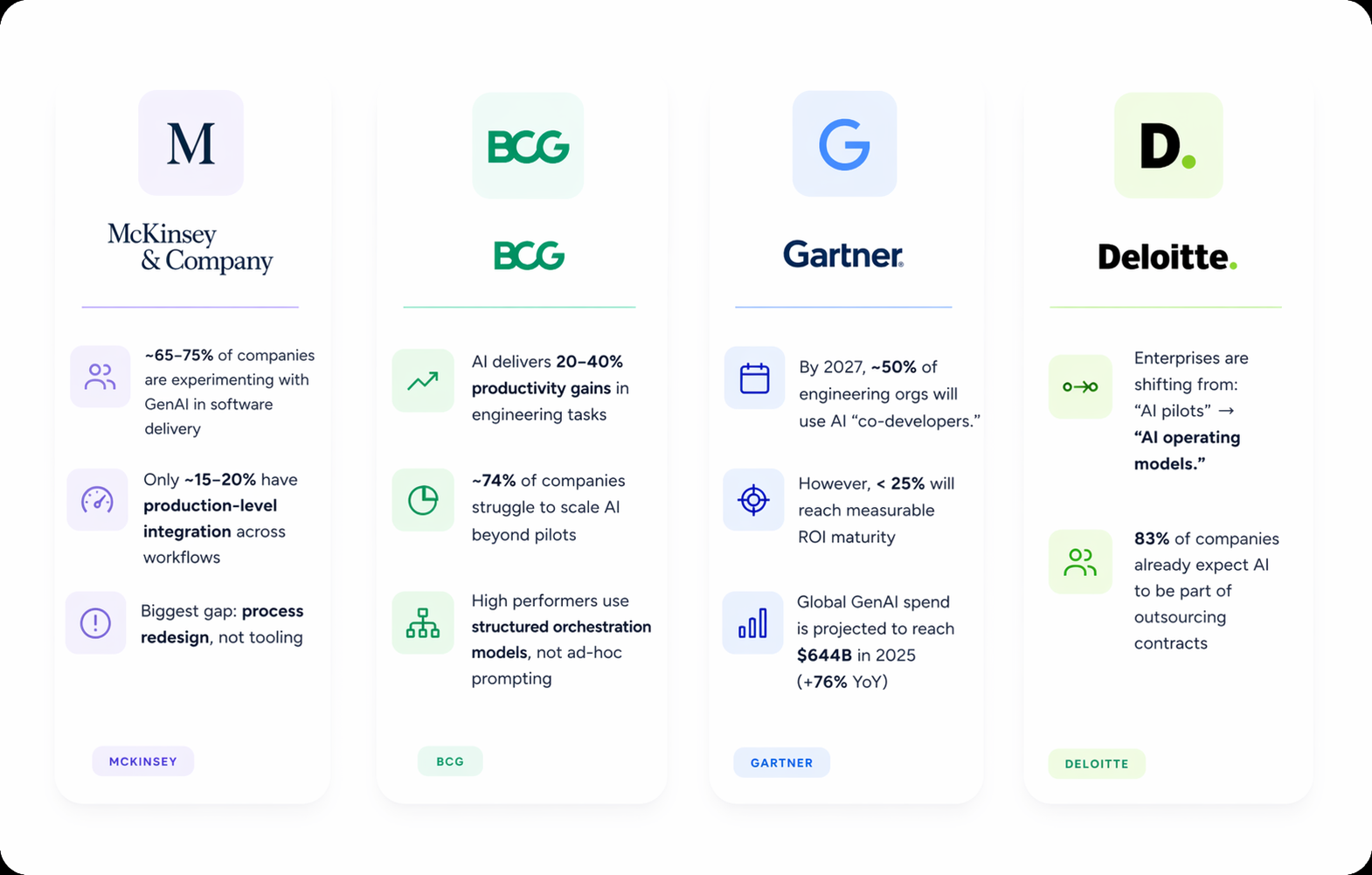
Mckinsey & Company, BCG, Gartner & Deloitte AI reports excerpts
This is what creates the delivery maturity gap:
- teams generate more output than they can reliably ship
- AI improves individual tasks but not system performance
- organizations scale experiments, but not outcomes
Most companies don’t lack AI but need a system to control its usage. And without that system, more AI doesn’t improve delivery — it amplifies the gap.
The uncomfortable truth is that AI alone doesn’t inevitably guarantee speed
One of the most overlooked findings comes from METR. In a controlled study with experienced developers, the use of AI tools resulted in 19% slower task completion times, despite participants expecting significant speed improvements.
The reason was not poor tooling, but incorrect delegation, high verification overhead, and lack of structured workflows. This directly challenges the dominant narrative that AI doesn’t inherently make teams faster — it amplifies how well (or poorly) work is structured.
There are two perspectives across Reddit,
Hacker News, X, and Substack:
Founders are optimistic
- AI acts as a leverage multiplier
- small teams replace larger organizations
- validation and iteration speed increases
- “AI-native companies” become the default
Engineers are skeptical
- low trust in AI-generated output
- increased cognitive load from constant verification
- concerns about hidden technical debt and security risks
- perception that AI reduces quality in complex systems
Both sides are right — and both miss the same problem
AI does accelerate output, but raw output isn't delivery. Without a structured system, faster generation creates pressure on everything that follows, because:
- teams generate more than they can verify
- decision ownership becomes unclear
- workflows fragment across tools and prompts
- costs increase through retries, loops, and rework
Three models of modern software product development
| Feature | Our AI-orchestrated delivery model | AI-native development model | Traditional development model |
| Core approach | Structured system combining AI + senior expertise | Heavy reliance on AI tools | Manual execution by the team |
| Speed | Fast and stable due to controlled execution | Fast in demos, inconsistent in reality | Slow, limited by team capacity |
| Quality control | Multi-layer validation (human + automated) | Unpredictable, errors often surface late | Depends on manual QA and reviews |
| Cost structure | Pay for outcomes and defined milestones | Costs fluctuate due to retries and rework | Pay for hours and iterations |
| Predictability | High — structured delivery process | Low — outputs depend heavily on learned patterns | Medium — depends on team discipline |
| Scalability | Scales through systems, not headcount | Limited by instability and control issues | Requires hiring more people |
| Client involvement | Low — direction instead of micromanagement | Very high — constant validation and fixes | High — constant management required |
| Transparency | Full visibility in real time | Fragmented across tools | Limited to reports and demos |
| Delivery risk | Controlled risk through validation layers | Broken outputs, instability and rework | Delays, scope creep, budget overruns |
To understand where AI orchestration fits, it helps to compare it with the two main models used today. Traditional development is structured and fully managed by humans. It is predictable, but it does not scale well and becomes expensive as complexity increases.
AI-native development is fast and flexible, but it often lacks consistency, control, and production stability. AI orchestration sits in between these two approaches. It combines structure with automation.
The key difference is how to control & manage execution.
AI orchestration resets the founders’ role in software development projects
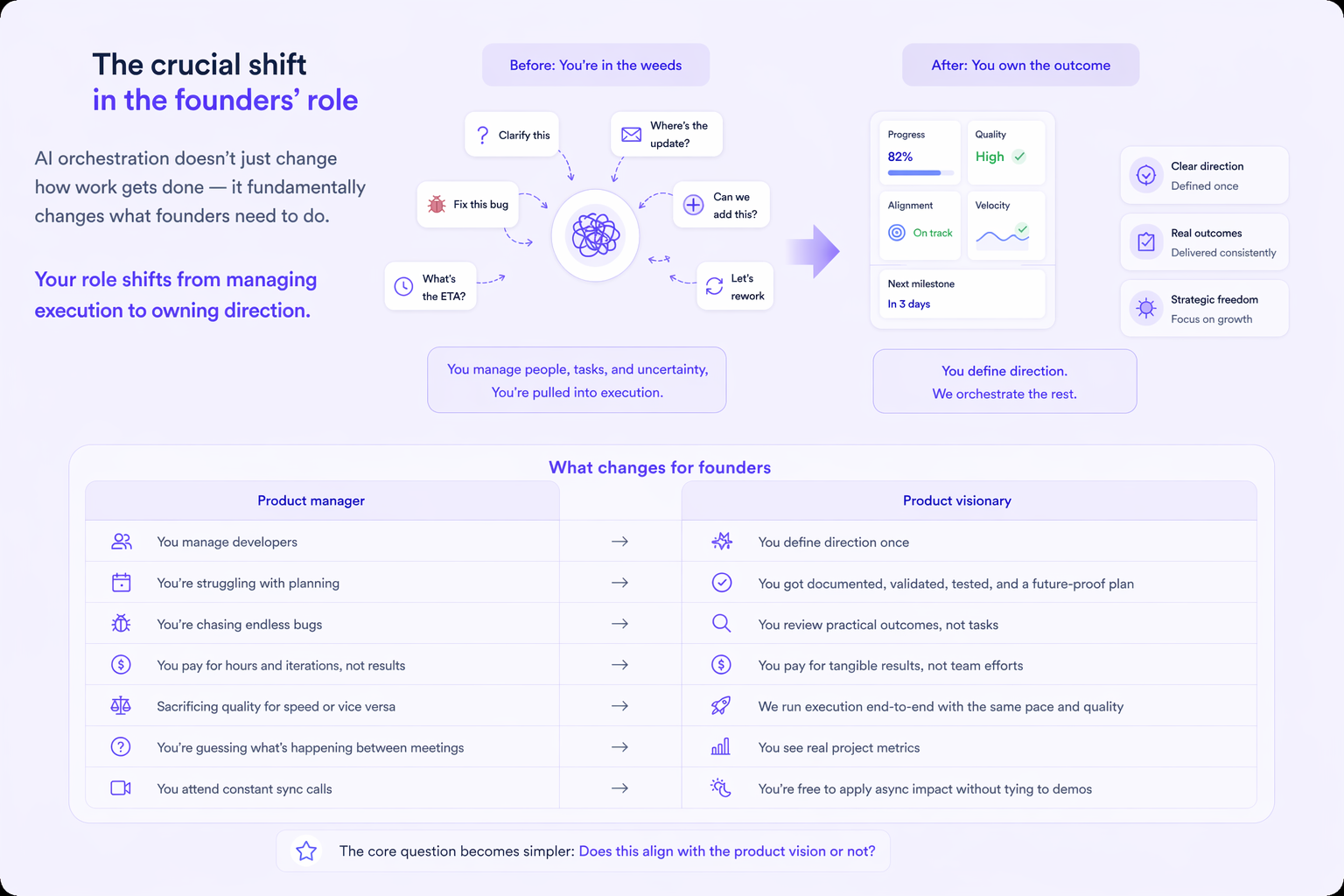
The key shift in the product leaders' and founders' roles
Perhaps the most underestimated impact of AI orchestration is not technical, but organizational.
In traditional setups, the client is often pulled into execution — managing teams, clarifying tasks, and tracking progress. In AI-native environments, this becomes even more extreme, with clients effectively acting as project managers for AI outputs.
Our custom delivery model is optimal compared to both classic and AI-native approaches because the central question becomes — does this align with the product vision or not?
Who actually runs this system
To understand AI-orchestrated delivery, it’s useful to zoom out from tools and look at something more fundamental — how teams are structured to produce value.
Traditional software delivery is still built around a role-heavy model — where progress is a function of coordination between specialists. AI-native teams, on the other hand, reduce coordination cost but increase system instability.
AI orchestration changes the structure entirely. Instead of scaling people per function, it scales decision quality, execution routing, and system design.
| Dimension | Traditional outsourcing team | AI-orchestrated delivery system |
| Core structure | BA + Project Manager + Product Manager + Designers + Devs + QA | 2–3 senior experts + AI orchestration layer |
| How work is produced | Task distribution across roles | System-driven execution with AI handling routine layers |
| Cost logic | Pay for hours, roles, and team size | Pay for outcomes and delivered milestones |
| Client involvement | Continuous clarification, alignment meetings, and task prioritization | Client defines direction, system handles execution |
| Coordination model | Heavy PM dependency (meetings, tickets, syncs) | Async system with structured validation loops |
| Scaling model | Add more people → add complexity | Improve orchestration → increase throughput |
| Risk distribution | Diffused across roles (ownership gaps common) | Centralized ownership with clear accountability |
Summary: Why does AI orchestration change the software development process?
AI orchestration changes software development by bridging the gap between rapid generation and reliable delivery. AI already enables teams to generate code and prototypes quickly, but most teams still struggle to turn that output into stable, production-ready systems. The problem is not generation — it is coordination, validation, and ownership.
AI orchestration introduces a structured system where:
- AI handles execution
- humans make decisions
- the system controls validation and delivery flow
This shifts software development from fragmented workflows to controlled delivery.
As a result:
- execution becomes predictable instead of reactive
- coordination overhead between roles is reduced
- responsibility is clearly defined instead of fragmented
For product leaders, this means they focus on direction and outcomes, while the system manages execution and consistency.
Let's turn your vision into a digital product!
Click here to share details with our team.
FAQ
What is AI orchestration in product development?
AI orchestration is a structured way to run product delivery where AI, engineers, and workflows operate as a single system. It defines how work is broken down, who executes each part, and how outputs are validated before they reach production. The goal isn't faster generation, but controlled and reliable delivery.
How is AI orchestration different from AI-native development?
AI-native development relies heavily on AI tools to generate outputs quickly. This often leads to fragmented workflows and high validation overhead.
AI orchestration, in contrast, controls how AI is used within the system. It introduces clear task routing, validation layers, and ownership, so speed does not come at the cost of stability.
Why do AI-powered projects might fail after the demo stage?
Because generation is not the same as delivery. AI can produce working code or prototypes quickly, but real products require integration, validation, and consistency across systems. Without structured coordination, outputs that look correct in isolation fail under real conditions.
Does AI orchestration reduce development time?
Not always in a linear way. AI orchestration reduces wasted time — rework, misalignment, and coordination delays — rather than just accelerating individual tasks. As a result, overall delivery becomes faster and more predictable, even if some steps include additional validation.
How does this approach affect costs?
Costs become more predictable because they are tied to outcomes, not time.
Instead of paying for:
- hours worked
- number of people involved
- iteration cycles
You pay for:
- defined milestones
- completed features
- validated results
This reduces the risk of budget overruns caused by rework and unclear scope.
What role does AI actually play in this model?
AI is used as an execution layer.
It handles:
- drafting code and documentation
- generating test cases
- supporting research and breakdown
But it doesn't make final decisions. All critical aspects — architecture, validation, and production readiness — remain under human control.
Read more
 advantage
 Book a call
Fill out the form
or brief with questions



 LinkedIn
 Instagram
Welcome to Goodface privacy notice.
Goodface respects your privacy and is committed to protecting your personal data. This privacy notice will inform you as to how we look after your personal data when you visit our website (regardless of where you visit it from) and other sites we own and operate. And tell you about your privacy rights and how the law protects you.
We may change the privacy policy from time to time to reflect changes to the products and services that we provide and how we process your personal data.
We will not share your information with any third party outside of our organization, other than as necessary to fulfil your request if any."
INFORMATION WE COLLECTWhen you visit our website, our servers may automatically log the standard data provided by your web browser. This data is considered “non-identifying information”, as it does not personally identify you on its own. It may include:
- Your computer’s Internet Protocol (IP) address;
- Your browser type and version;
- The pages you visit;
- The time and date of your visi;
- The time spent on each page;
We may ask for personal information, such as your name and email address. This data is considered “identifying information”, as it can personally identify you. We only request personal information relevant to providing you with a service, and only use it to help provide or improve this service.
We collect information by fair and lawful means, with your knowledge and consent. We also let you know why we’re collecting it and how it will be used. You are free to refuse our request for this information, with the understanding that we may be unable to provide you with some of your desired services without it.
We will only process personal data and communicate with you if:
1. You have given us consent to the processing of your personal data and communicating for one or more specific purposes i.e. requesting products or services from us, downloading material or information from our website or submitting a contact us form.
2. Performance of a contract
3. Where we have a legitimate interest for contacting you in relation to our products and services
DATA PROCESSING AND STORAGEWe only retain personal information for as long as necessary to provide a service, or to improve our services in future. While we retain this data, we will protect it within commercially acceptable means to prevent loss and theft, as well as unauthorised access, disclosure, copying, use or modification. That said, we advise that no method of electronic transmission or storage is 100% secure, and cannot guarantee absolute data security.
Rights and choices of individuals:
- See what data we have about you, if any;
- Change/correct any data we have about you;
- Have us delete any data we have about you;
- See what security measures we apply to your data;
- Express any concern you have about our use of your data;
You may opt out of any future contacts from us at any time. You can do the following at any time by contacting us via the email address given on our website: goodface.agency
Got questions or want to discuss a project?


