

Why don’t AI tools make product teams faster without orchestration?


Updated at
16.06.2026
TL;DR
AI tools don't make product teams faster by default because they operate on individual tasks, rather than on the entire delivery process those tasks belong to. When a developer writes code faster, but the review, handoff, and validation steps remain the same, the pipeline becomes visibly fuller.
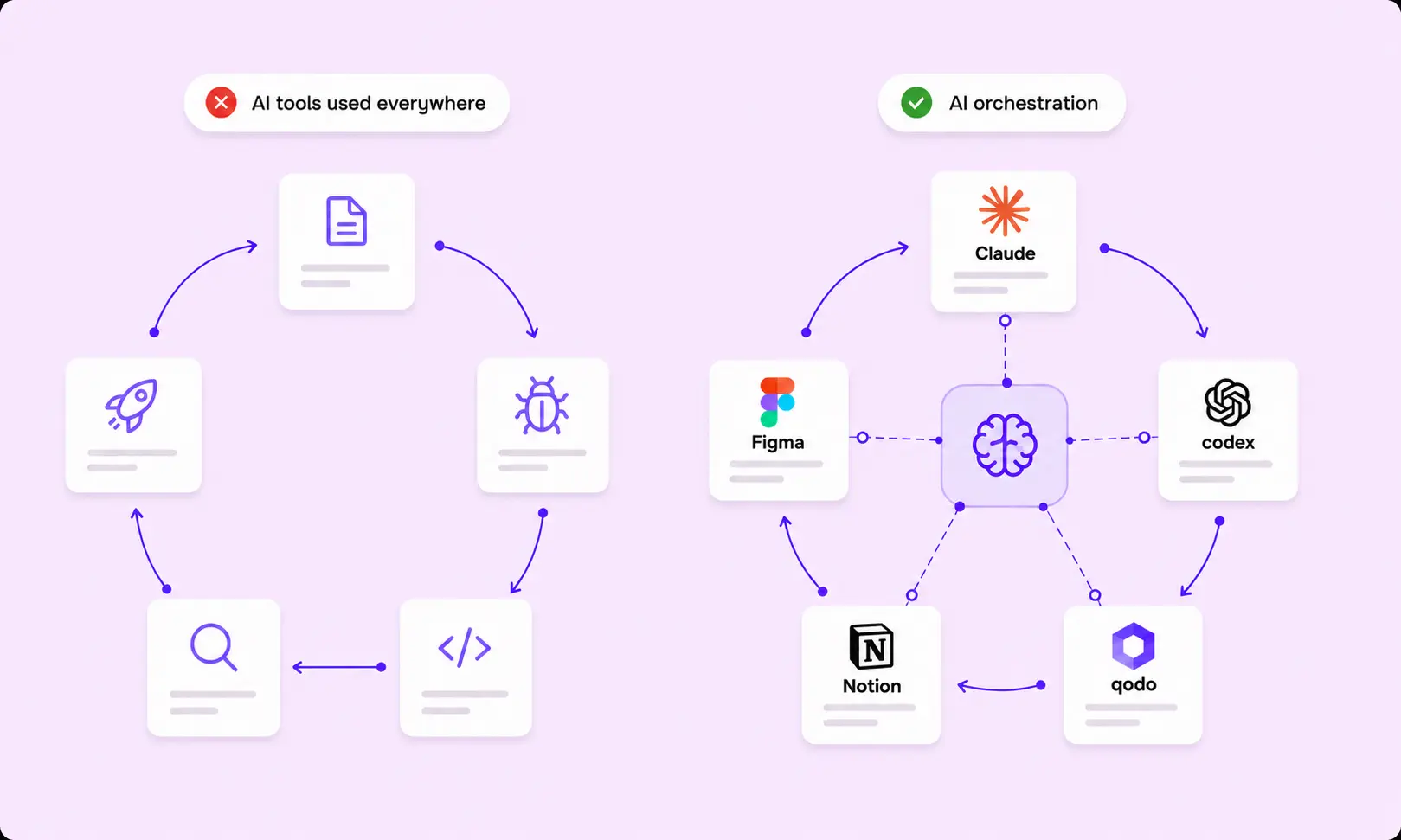
The real challenge in most teams is the upstream issues that AI tooling doesn't touch: unclear requirements, unresolved decisions, and handoffs with blurred accountability. Adding more AI to that environment generates more noise. AI orchestration organizes the toolset around the entire SDLC, accelerating the right processes without ignoring existing constraints.



Why don’t AI tools make product teams faster? | 01:40 min
No time to read? Explore through headphones, speakers, or on the go.
Isolated AI inputs confuse the product team’s alignment in the SDLC process
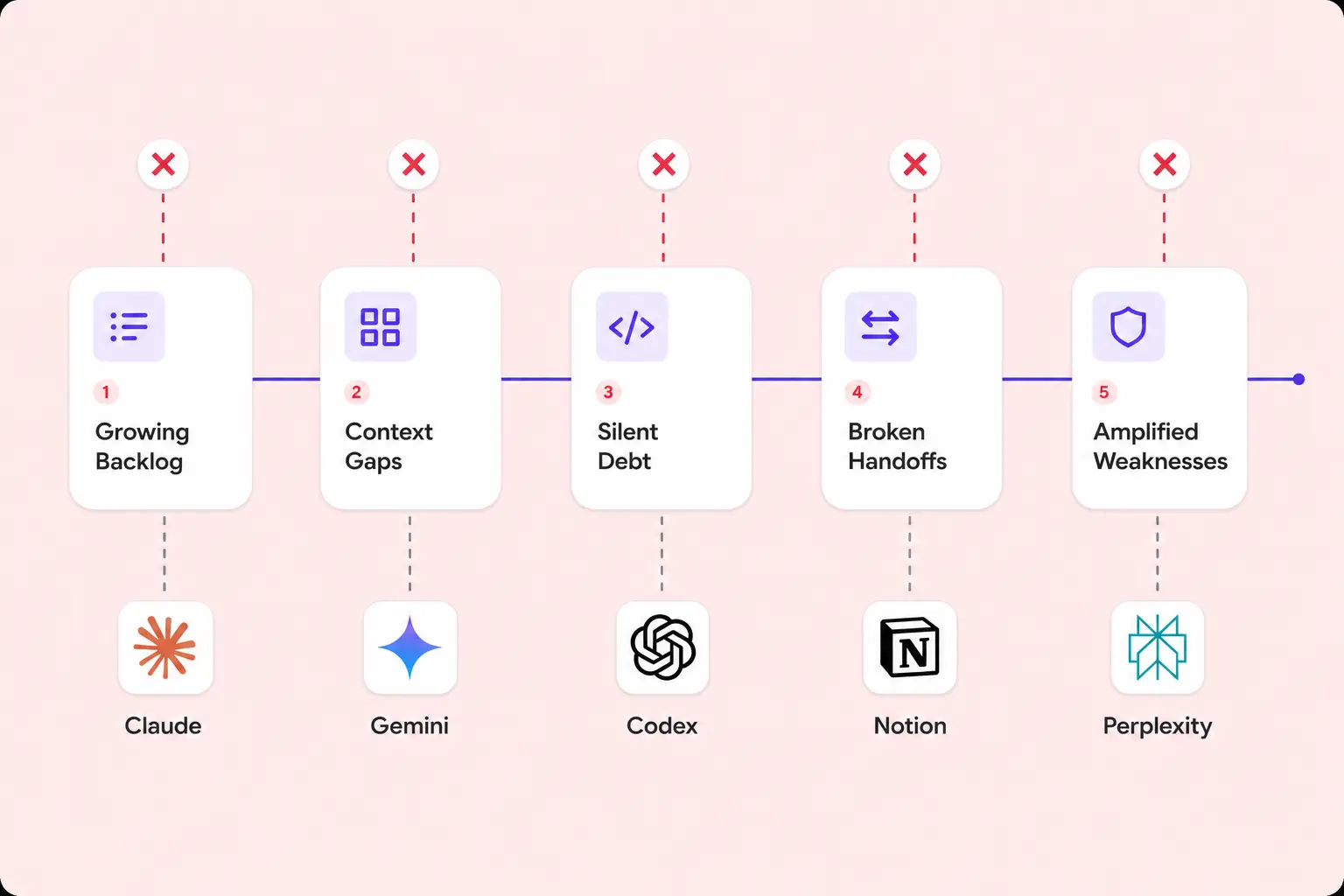
1. You're generating more than you can review
AI tools produce code, test cases, design variations, and documentation faster than any team can verify. When a developer generates three times the code in a day, the review queue triples — and reviewers don't get faster automatically. The bottleneck shifts from writing to reviewing, and the backlog quietly grows.
2. AI has no idea what your product actually needs
A code assistant knows the files it can read. A design tool knows the brief you typed. Neither knows about the compliance constraint added two months ago, the architectural change after last quarter's scaling issue, or the UX decision that never made it into the docs. AI generates confidently from what it has — and when the missing context matters, the output looks fine until the gap surfaces downstream, where fixing it costs far more.
3. The technical debt is invisible until it isn't
AI-generated code solves the task at hand without asking whether that solution fits the broader system. Patterns conflict with existing architecture. Shortcuts make sense locally but not systemically. Unlike debt from developers cutting corners, this kind looks clean — it accumulates quietly until a routine feature becomes a refactoring project.
4. Handoffs between departments get messier
Clear handoffs require an agreed scope, defined specs, and documented decisions. Without that, AI makes things worse: a designer shares three of twelve generated layouts via Slack, a developer builds to the spec as written rather than the intent behind it, and a QA engineer tests against docs that were never properly reviewed. Everyone did their job. The gap between them widens anyway.
5. If your process was already fragile, AI just reinforces that
AI doesn't repair a broken delivery process. It runs faster inside one, hitting the same walls at a higher speed, producing more output that gets stuck in the same places. Strong processes with clear accountability see real gains. Fragile ones see the same problems at greater volume.
Faster coding or testing can’t fix late product delivery
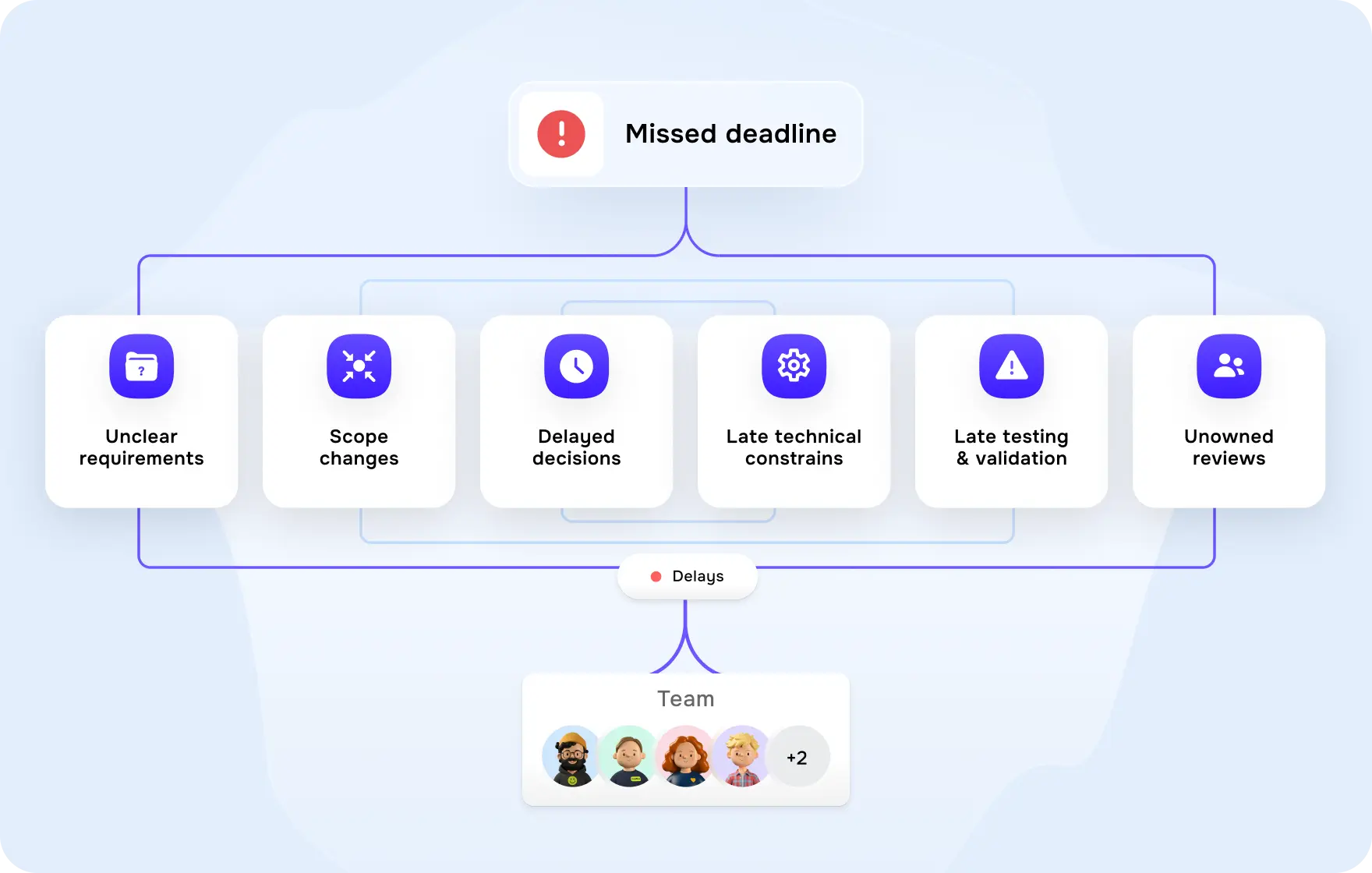
Late deliveries rarely stem from slow developers or under-tested code. When teams actually investigate a missed deadline — not to assign blame, but to follow the thread back — the cause usually appears weeks before development was even affected. The missed deadline is often just the visible tip of a much larger iceberg of product decisions, unresolved assumptions, and process gaps that accumulated earlier in the delivery cycle.
What causes software delivery delays?
- The team started implementation before the requirements were clear.
- The scope grew after development was already running, forcing work to be redone.
- Product and design decisions got postponed until execution made them unavoidable — and by then, changing direction was expensive.
- Security or technical constraints surfaced late and forced architectural changes nobody budgeted for.
- The team pushed validation to the end of the cycle, where fixing a bug costs five times what it would have cost to catch it earlier.
- Reviews had no clear owner, so under deadline pressure, the team skipped them.
None of these issues originates in code, but in planning, alignment, and decision-making.
What a controlled AI-orchestrated SDLC workflow looks like
Human-led AI-assisted delivery isn’t complicated. It has one rule: AI generates, humans validate, then and only then does the work move forward.
No handoff to the next without a named person signing off. AI doesn’t bypass decision points, but strictly executes within them.
This is the difference between AI tooling and AI orchestration. Tooling is what individual contributors use. AI orchestration is a product delivery framework that coordinates dozens of AI tools to produce reliable and anticipated outcomes rather than chaotic outputs.
| Stage | What AI can help with | What humans must own |
| Discovery & research | Processing interviews, synthesizing feedback, and competitive summaries | What the research means, what to build next |
| Requirements & scoping | Drafting user stories, flagging ambiguities, and first spec versions | What goes in, what stays out, acceptance criteria |
| UX & design | Layout concepts, interaction variations, option exploration | Architecture of the experience, what actually ships |
| Development | Component generation, boilerplate, codebase analysis | System design, data modeling, code review |
| QA & testing | Test case generation, regression preparation, edge case coverage | Test strategy, final call on production readiness |
| Documentation | First drafts of technical and user-facing content | Accuracy, completeness, sign-off |
Doubt how to create your product with AI? We have no doubts, so fill the form and let's do it together.
Where does AI assistance genuinely strengthen SDLC?
To be direct: this article is not arguing against AI. It's arguing against adopting AI without changing anything else and expecting different results.
There are specific places where AI makes a real difference for product teams:
- User research at volume. Interviews, support tickets, and feedback surveys generate more text than any team can manually process under a normal sprint cycle. AI that surfaces patterns in that data means product decisions get made on more evidence, faster. The judgment call still belongs to a human.
- Documentation that actually gets written. Documentation is the first thing cut when a sprint gets tight. AI-assisted drafting means it gets done — which matters for onboarding, QA, and the next team working in this codebase.
- Design exploration without the time cost. A designer evaluating more options in less time makes better final decisions — a human choice made from a wider set of possibilities, not an AI-generated result handed over.
- Test coverage that doesn't slip. AI-prepared test case libraries cover the edge cases that get dropped when time is short. The test strategy stays human. The library doesn't have to be built by hand.
- Component code within a defined architecture. When the spec is clear and the architecture is documented, AI coding assistants generate reliable, consistent output. That "when" carries the full weight of the sentence.
What should your team own during the AI product development process?
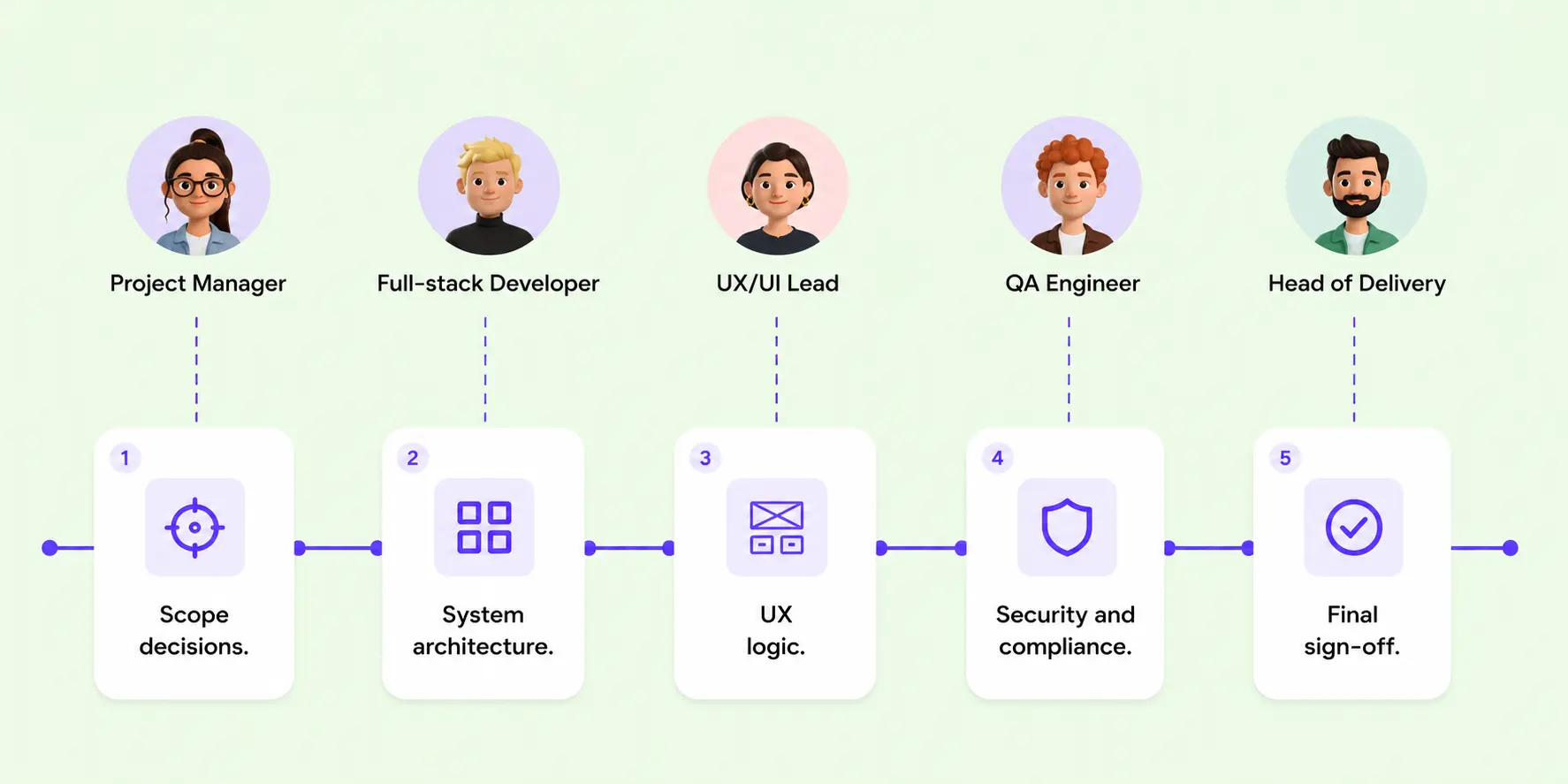
- Scope decisions. AI can draft a spec from a brief. It cannot decide what the product should do, what to cut, or how to sequence the work. Those calls require context that lives with the team.
- System architecture. Service boundaries, data models, and integration design — these decisions carry consequences that compound over time. They need engineers with product context, not a well-phrased prompt.
- UX logic. Generating layout variations is one thing. Designing an experience that works for a specific user in a specific situation requires research-grounded judgment, not generation.
- Security and compliance. Regulatory requirements do not self-validate. A specialist who understands the constraints needs to review the output — not assume the tool handled it.
- Final sign-off. Someone on your team is responsible for what ships. AI does not accept that responsibility. It shouldn't.
A simple checklist for reviewing AI outputs
Most AI-related delivery problems trace back to one thing: an output that moved downstream without proper review. Before any AI-generated work advances to the next stage, someone should be able to answer yes to all of these:
- Does this match the product goal — not just the prompt it came from?
- Does it fit the existing architecture, or does it introduce conflicts?
- Has anyone checked it for security implications specific to this product?
- Will another engineer be able to understand and maintain this in six months?
- Does it follow the UX patterns and design system already in place?
- Is there a named person who owns this output and can defend it?
When AI product development tools start working against you
Not every situation benefits from AI involvement. These are the conditions where it actively slows teams down:
- Unclear requirements fed into AI. AI generates from what it receives. Vague brief in, confident-looking but wrong output out — discovered at the handoff, not at generation.
- Code that skips architectural review. Output that works in isolation but conflicts with the existing system creates compounding problems. The earlier you catch it, the less it costs.
- More output than the team can evaluate. If AI generates faster than the team can review, something gets skipped. The only sustainable fix is to enhance review capacity, rather than generate less.
- AI is used to avoid a hard decision. Five AI-generated design concepts do not replace a conversation about what the product needs to do. A generated spec draft does not replace alignment on scope. Using AI output as a substitute for thinking creates downstream problems that no tool will fix.
- No one is accountable for the output. When a production bug traces to an AI-generated change that nobody reviewed, you have an accountability gap — and it will happen again.
Your team doesn't need more AI to enhance product delivery
Over the past year, we've seen teams add AI tools to discovery, design, development, and testing. The expected result was faster delivery.
What usually happened was more complicated. Work moved through the early stages faster, but review and integration took longer. Senior engineers spent more time checking outputs, resolving inconsistencies, and revisiting decisions that were never documented.
The teams getting the most value from AI weren't necessarily using more tools. They had clear rules for where AI could be used, who reviewed the output, and what had to happen before work moved to the next stage.
If your team is experimenting with AI across the SDLC, it may be worth looking at the workflow before adding another tool. Our AI orchestration guide covers how to build that process.
Want to build your next-gen product with the Goodface? Reach out here and let's implement your vision.
Frequently Asked Questions
Why don't AI tools make product teams faster by default?
Because faster tasks inside the same process create more output for the same bottlenecks to absorb. Delivery speed depends on decisions, handoffs, and validation — not on how quickly individual contributors produce work. Speed up generation without changing anything else, and the pipeline gets fuller, not faster.
What is AI orchestration for product teams?
It's the process design that determines where AI contributes, what it produces, how outputs get reviewed, and who owns the outcome. Every AI output has a named reviewer before it moves to the next stage. Orchestration is what makes tools deliver consistently without extra costs, time spent, and delays.
What are the real risks of unreviewed AI output?
Technical debt that accumulates quietly and surfaces badly. Outputs that match the prompt but miss the product goal. Handoffs that look complete but encode unresolved decisions. Accountability gaps when something fails in production, and nobody can say who reviewed it.
How should teams evaluate AI-generated outputs?
Run the same check on every output before it advances: does it match the product goal, fit the architecture, pass a security check, hold up for maintainability, follow UX patterns, and have a named owner? Mandatory checklist application beats an occasionally conducted thorough review.
Can AI actually help teams build MVPs faster?
Yes — when the product is defined before AI starts generating. MVP development benefits from AI-assisted docs, test prep, and component generation for well-scoped features. The problem is that AI cannot accelerate an unclear spec. It just produces unclear output faster.
What does a human-led AI workflow actually look like in practice?
Each stage has defined AI contributions and a human review before anything moves. Research is AI-processed and reviewed by a product lead. Specs are AI-drafted and validated before development starts. Code is AI-generated and reviewed by a senior engineer. Test cases are AI-prepared and validated by QA.
Read more

 Book a call
Заповніть форму або
бриф із запитаннями



 LinkedIn
 Instagram
Welcome to Goodface privacy notice.
Goodface respects your privacy and is committed to protecting your personal data. This privacy notice will inform you as to how we look after your personal data when you visit our website (regardless of where you visit it from) and other sites we own and operate. And tell you about your privacy rights and how the law protects you.
We may change the privacy policy from time to time to reflect changes to the products and services that we provide and how we process your personal data.
We will not share your information with any third party outside of our organization, other than as necessary to fulfil your request if any."
INFORMATION WE COLLECTWhen you visit our website, our servers may automatically log the standard data provided by your web browser. This data is considered “non-identifying information”, as it does not personally identify you on its own. It may include:
- Your computer’s Internet Protocol (IP) address;
- Your browser type and version;
- The pages you visit;
- The time and date of your visi;
- The time spent on each page;
We may ask for personal information, such as your name and email address. This data is considered “identifying information”, as it can personally identify you. We only request personal information relevant to providing you with a service, and only use it to help provide or improve this service.
We collect information by fair and lawful means, with your knowledge and consent. We also let you know why we’re collecting it and how it will be used. You are free to refuse our request for this information, with the understanding that we may be unable to provide you with some of your desired services without it.
We will only process personal data and communicate with you if:
1. You have given us consent to the processing of your personal data and communicating for one or more specific purposes i.e. requesting products or services from us, downloading material or information from our website or submitting a contact us form.
2. Performance of a contract
3. Where we have a legitimate interest for contacting you in relation to our products and services
DATA PROCESSING AND STORAGEWe only retain personal information for as long as necessary to provide a service, or to improve our services in future. While we retain this data, we will protect it within commercially acceptable means to prevent loss and theft, as well as unauthorised access, disclosure, copying, use or modification. That said, we advise that no method of electronic transmission or storage is 100% secure, and cannot guarantee absolute data security.
Rights and choices of individuals:
- See what data we have about you, if any;
- Change/correct any data we have about you;
- Have us delete any data we have about you;
- See what security measures we apply to your data;
- Express any concern you have about our use of your data;
You may opt out of any future contacts from us at any time. You can do the following at any time by contacting us via the email address given on our website: goodface.agency
Лишились питання або хочете обговорити проєкт?


