

Rebranding after AI: when your product outgrows your brand




Rabranding after AI: when your product outgrows your brand
No time to read? Explore through headphones, speakers, or on the go.
TL;DR
- AI tools made launch brands cheap, but they rely on the same defaults as thousands of other products, so they look generic and have no system behind them.
- A product has outgrown its brand when the brand sets lower expectations than the product meets, which costs you in sales and hiring.
- In AI-built products, the rebrand has to reach the codebase through design tokens, or the app stays on the old look.
- Keep what users recognize, rebuild what came from defaults, and refresh instead of rebranding if only the visuals have aged. A rebrand will not fix weak retention or missing product-market fit.
Brand debt: the gap nobody puts on the roadmap
Engineering teams log tech debt; product teams log UX debt. Neither backlog has a ticket for the gap between what the product does today and what the brand still says it does. We call that gap brand debt. Like the other two, it compounds while nobody is watching, and it usually gets paid down under pressure, right before a funding round or a market launch.
The gap comes from two release schedules that were never synced. Product ships every two weeks. Positioning gets revisited only when an investor deck or a new market forces it.
Before AI, the drift was slow enough to live with: a two-year-old homepage got details wrong, but it still described what the company sold. AI releases change the core offer. A shift like that rewrites the buyer’s answer to “what are we paying for?” in a single release.
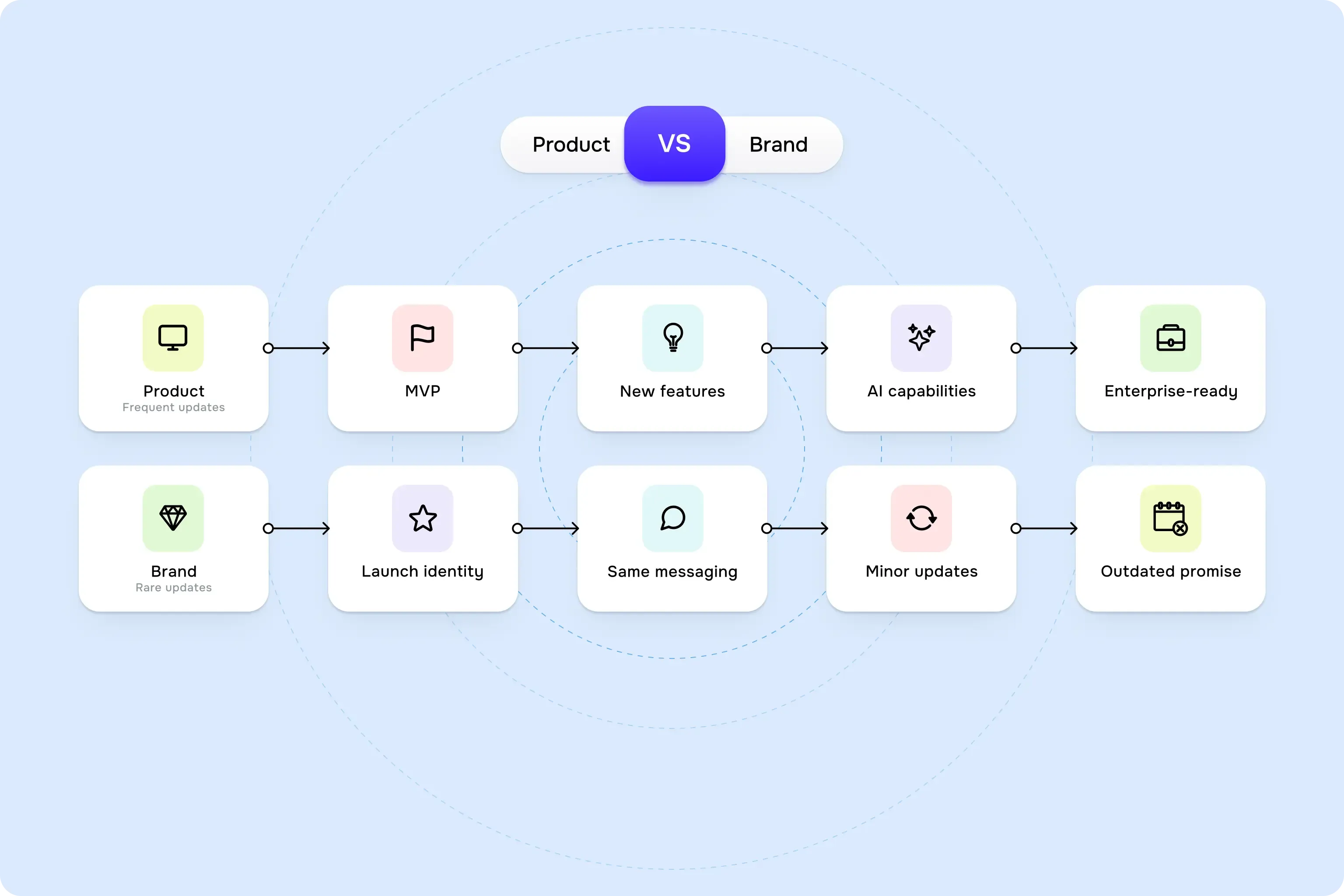
Brand debt never appears as a line item. You find it in demos where the account executive’s first slide corrects your own website. For a growth-stage company, the timing makes it expensive: the product finally has something new to sell, and the brand is still pitching the old version.
Here’s a ten-minute check: put your homepage H1 next to your latest release notes. If the headline was just as accurate before that release shipped, you’re carrying brand debt, and your sales team is already paying the interest.
Why a product built with AI ages twice
The two-clock problem describes a product that falls behind in how it was built and in what its AI does for users, at the same time and for different reasons.
A foundation built faster than anyone could review
The build clock measures the foundation: code quality, architecture, security, data model, and the UI system. It ages the way every MVP ages, only faster, because AI tools let a small team produce far more code than it can review.
An experience the market has already moved past
The AI clock measures the experience: how the product uses AI, what users must do to get value from it, and whether it still matches what users expect. It ages with the market, and the AI product market moves in months.
Why both clocks run fast
The twist is that both clocks run on the same fuel. AI made the first version cheap and fast to build. That same pace of change makes the first version outdated just as fast. A product built at the speed of the AI market ages at the same speed.
The clocks also hide each other. A team that rewrites fragile code feels it has modernized the product, even if the AI experience stays where it was in 2024. A team that ships a new agent feels current, even if the agent sits on a foundation that can't support it.
Six signals your product has outgrown its brand
A product has outgrown its brand when the brand sets lower expectations than the product meets. These six signals show where the gap usually opens. Two or more at once is a strong case for a rebrand.
1. Your buyer changed, your brand did not
You launched for indie makers and now sell to Heads of Operations at 200-person companies. If the homepage still speaks to the maker (playful tone, "ship faster" promises, no security or integration story), the new buyer has to translate it before taking you seriously.
2. Your name describes a tool, a feature, or a model
Lovable is a public example. The company launched its web product as GPT Engineer, and its own January 2025 post-mortem says users saw that name as a "fun tool" rather than a serious platform. The rebrand to Lovable also separated the commercial product from the open-source gpt-engineer CLI. A name tied to one model, one feature, or one workflow caps how far the product can stretch.
3. Your homepage passes the blind test for the wrong reason
Strip the logos off your homepage and three competitors' homepages, then show them to someone outside the team. If they cannot tell which one is yours, your brand is not doing its job in a shortlist.
4. Sales builds its own brand
Account executives make their own decks, rewrite the one-pager, and avoid sending prospects to the website. That workaround is the clearest internal signal that the official brand cannot carry an enterprise conversation.
5. You cannot own or defend what you have
The US Copyright Office concluded in January 2025 that prompts alone do not give a user enough control to claim authorship of the output. A logo generated from a prompt and used as is may therefore have no copyright protection, and a quickly picked name may collide with an existing trademark in your new market.
6. The product UI and the marketing site look like two companies
The site got a facelift last quarter, while the app still runs on generator defaults. Users notice the jump at the first login.
Spot these signals?
Goodface team will show where the gap opens.

What to keep from your AI-era brand and what to rebuild
| Brand asset | Keep it when | Rebuild it when |
| Name | People search for it, the community uses it, and it fits the category you are moving into | It names a model, a single feature or a tool; it collides with a trademark in your target market |
| Logo | A human designer built or substantially reworked it, and customers recognize it | It came straight from a generator and you cannot show human authorship |
| Color and type | One element is distinctive and already tied to you | It matches the AI defaults (indigo-violet gradients, Inter everywhere) |
| Product vocabulary | Users repeat your terms in support tickets and calls | The terms were invented at launch and nobody outside the team uses them |
| Positioning | It still describes the buyer you sell to today | It speaks to your first user persona and skips the questions your current buyer asks |
| UI components | They already reference shared styles | Styles are hard-coded per screen with no token layer |
The name deserves the most caution. Renaming resets search visibility and word of mouth, so it should be the last asset you change, and only when it actively blocks the next stage.
Keep, evolve or rebuild: three rebrands from the Goodface team
A rebrand depth should match how far the company has moved. In three recent Goodface projects, the answer ranged from keeping the logo to building a new identity from scratch. None of these products started with an AI-generated brand, but each team faced the same question an AI-built product faces after traction: which parts of the brand still carry the company, and which parts hold it back.
Ping Proxies (Byteful): carry the rebrand into the product
Ping Proxies, now operating as Byteful, is a UK startup with a SaaS platform for managing proxy servers. Its CEO came to us with a working product that looked dated. Once the work started, it grew into three linked redesigns: the brand identity, the web app and the website.
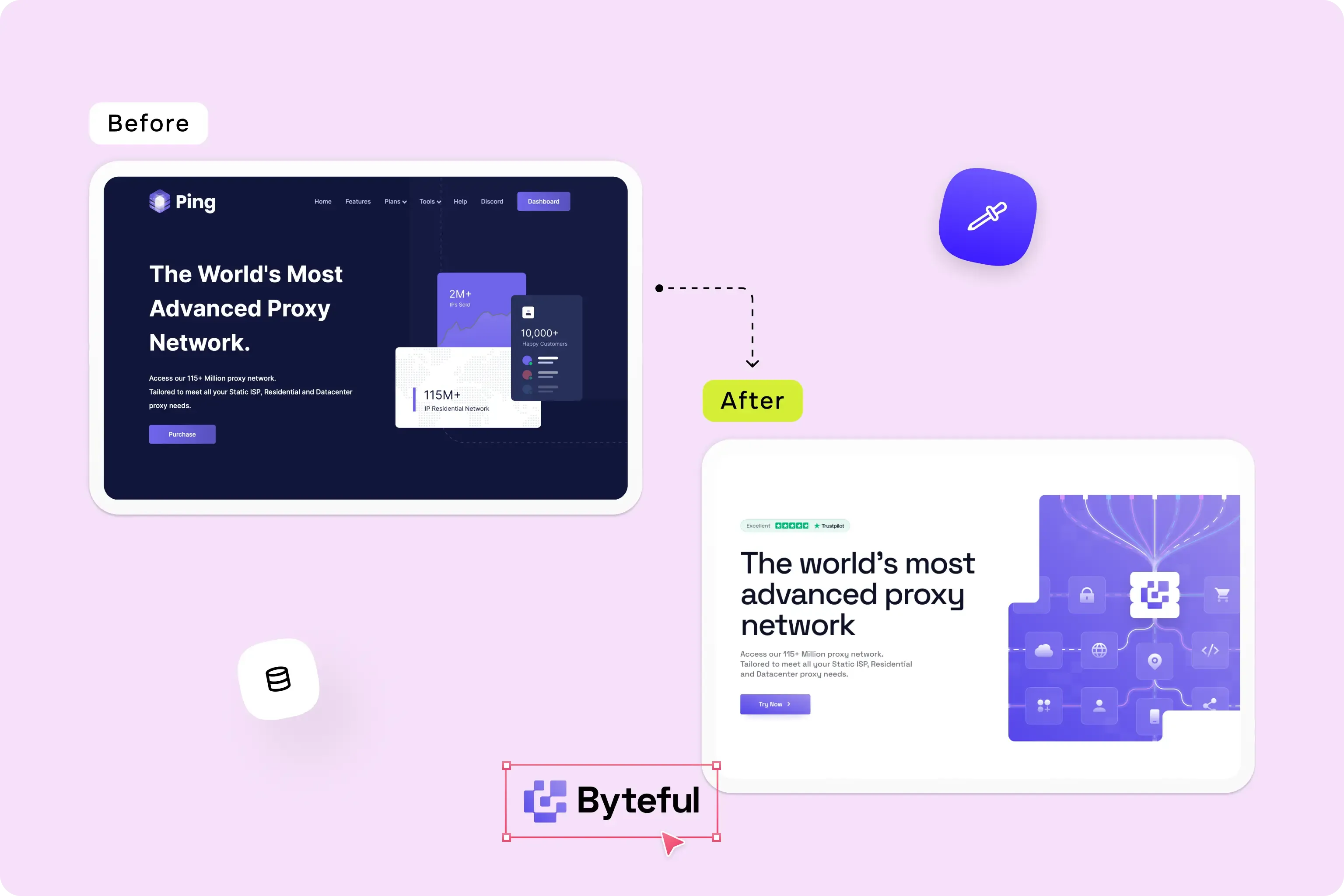
We set the new visual strategy first: a rebranded logo, adjusted colors, and cleaner shapes and fonts. Only after that system was approved did we design the dashboard and the website on top of it, so users would recognize the same product in the app and on the site. After launch, existing users praised the product's new look. This is the brand debt fix in practice: the new identity reached the dashboard users open every day, along with the marketing site.
Orbital: evolve the identity when the business widens
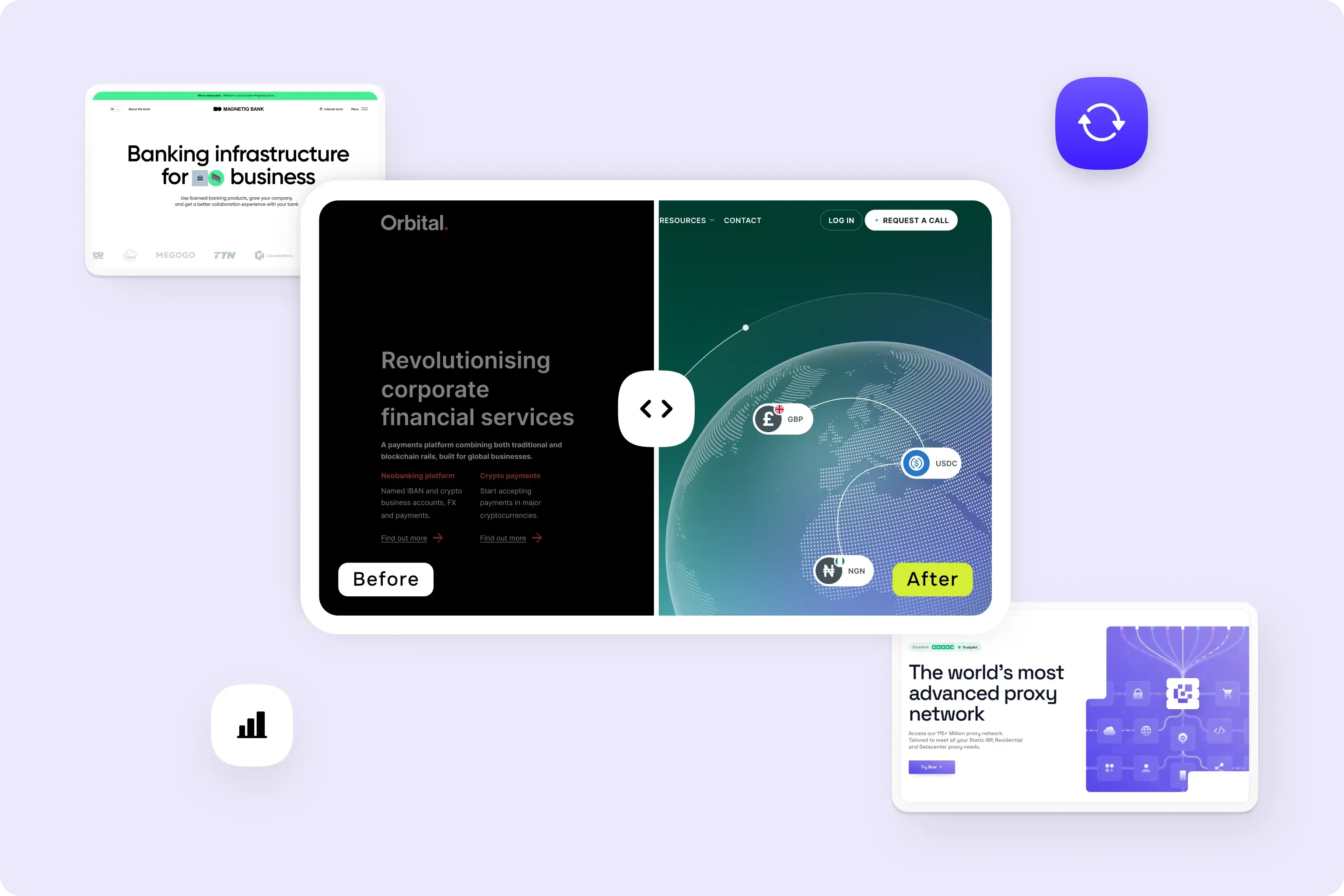
Orbital is a cross-border payments platform for enterprise clients. As it moved into new verticals, its existing brand and website no longer explained the payment infrastructure behind it. We evolved the identity instead of starting over: recognizable elements stayed, while typography, color logic and visual rhythm became structured enough to scale.
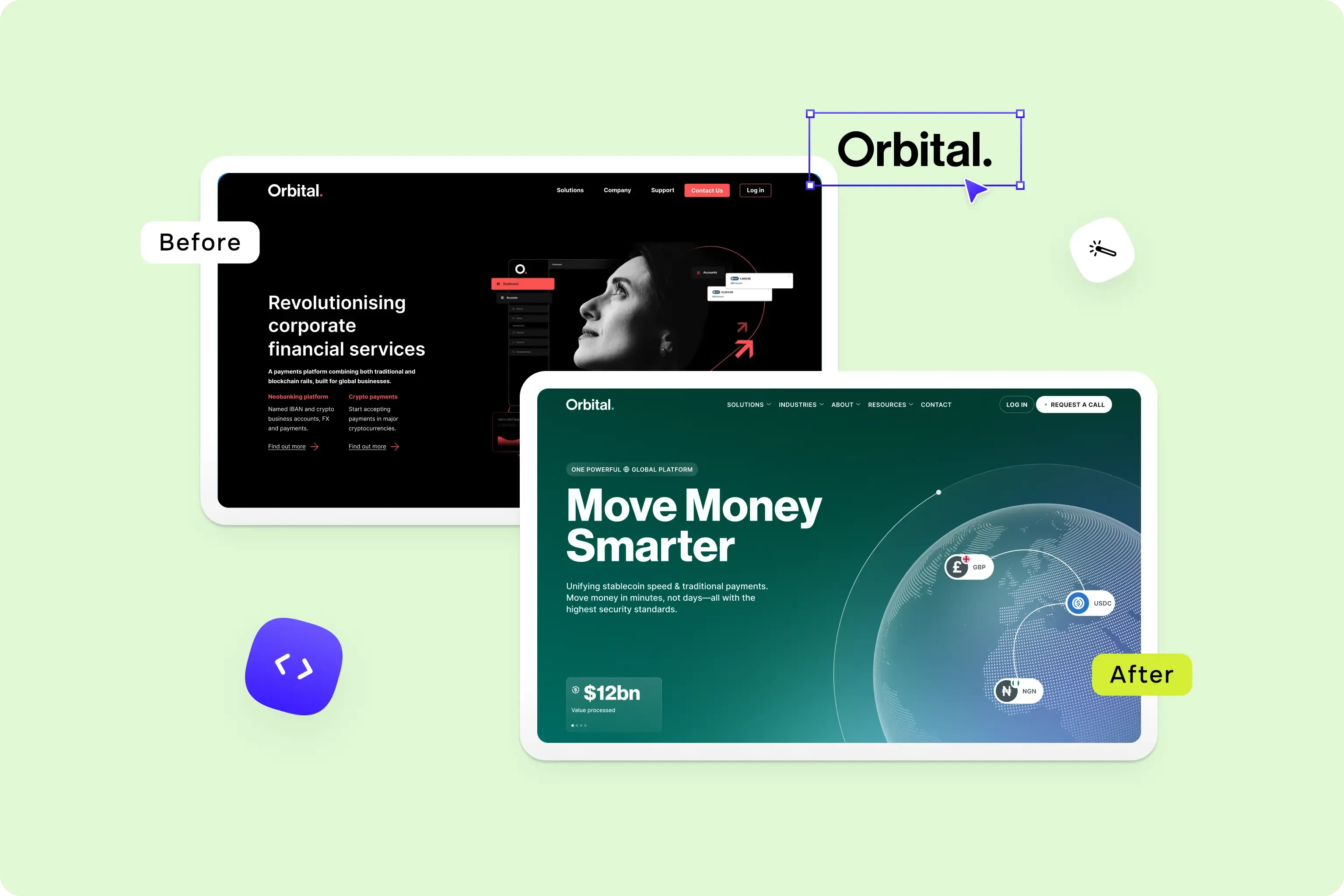
The team delivered a brand guide covering grids, type, palette and illustration, then a full design system on top of it. We also rebuilt the site navigation around how clients think (industries, services and capabilities) instead of Orbital's internal structure. According to the case, the design system cut the time Orbital's team needs to produce marketing materials, and Orbital kept working with us on presentations, campaigns and event visuals after launch.
Magnetiq Bank: rebuild everything, including the name
Magnetiq is a Latvian bank that offers banking services and FinTech products for businesses. It was preparing to enter new countries with more accessible products and needed a brand that could stand next to major European players. The scope went beyond visuals: a partner marketing team developed the positioning, the marketing strategy, and the Magnetiq name, and our team stepped in once the client approved them.
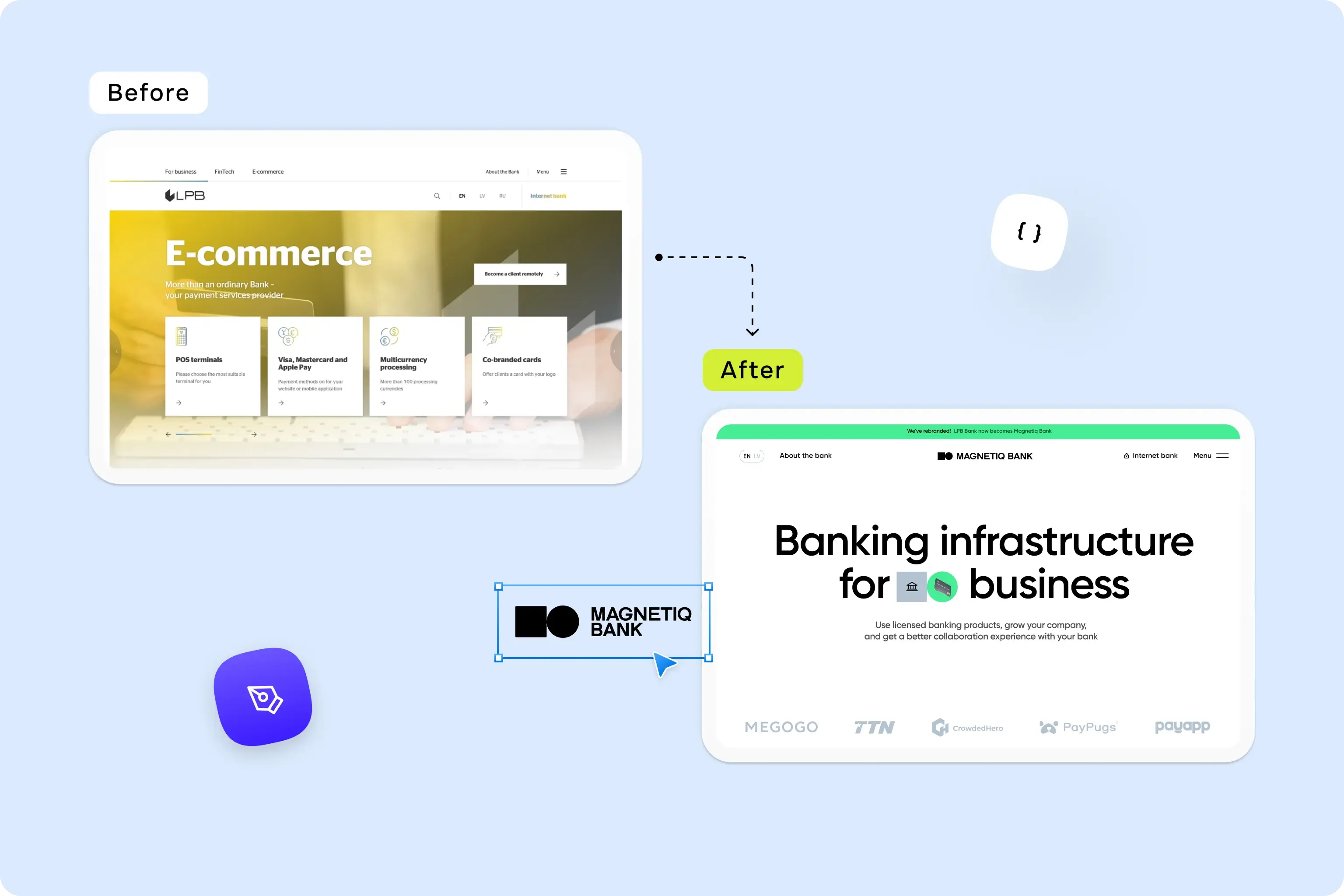
This rebranding project earned the Red Dot Award: Brands & Communication Design 2025
We designed the logo, the color and type system, and a brand book that grew into a full design system for digital and offline materials. The same system then went into the website and the bank's product interfaces.
Read together, the three projects follow the table above. Stacks Co kept the asset its ecosystem recognized, Orbital kept its recognizable core and rebuilt the system around new verticals, and Sensus rebuilt everything because its buyer changed.
Evolve, rebuild, or rename?
Tell us about your brand to envision the next step.
How to rebrand without losing the users you already have
A rebrand of a live product succeeds when existing users feel it as an upgrade to something they already trust. Run it in this order:
Start with sales and support data
Pull lost-deal notes, the objections from recent sales calls and the questions users repeat in support. They tell you which doubts the current brand creates.
Lock positioning before visuals
Write down who you sell to now, the category you compete in and the one claim you can prove. The identity work then has a brief to answer instead of a taste debate.
Design the identity as a system
Deliver tokens, a type scale, component states and usage rules along with the logo, so the product team and its AI tools can apply the brand without a designer in every pull request.
Move the product onto tokens before launch day
Replace raw values in the codebase so the new identity switches on across the app in one release, at the same moment as the website.
Protect search and links
Redirect old URLs and domains, keep the old name in page copy and metadata for a transition period ("formerly X"), and update directory profiles such as Clutch and G2 the same week.
Tell users why
Explain the change in product terms: what you now do, for whom, and what stays the same in their account. Lovable paired its new name with a relaunch for non-technical builders in late 2024, which gave users a product reason for the change.
When a rebrand is the wrong call
A rebrand fixes a perception gap. It cannot fix a product gap, and spending a quarter on identity while users churn is throwing good money after bad. Hold off in these cases:
- Users leave after they try the product. If trial-to-paid conversion is healthy but 90-day retention is weak, the brand is doing its job, and the product is not. Fix onboarding and core flows first.
- You have not found product-market fit. Before PMF, the audience and the offer can still change in a month. A brand built now will need rebuilding again after the next pivot.
- Only the visuals have aged. If the name, positioning, and buyer are still right, a visual refresh (new palette, type, illustration style, and tokens) costs less and keeps equity, a full rebrand would reset.
- The name already carries real demand. Branded search, community size, and press coverage are assets. Changing the name throws them away, so rebuild around it unless it blocks the next market.
Public rebrand stories also overstate what the name change did. Lovable renamed itself while relaunching the product for a broader, non-technical audience, so its growth afterward cannot be credited to the name alone. Treat any "we rebranded and revenue jumped" story the same way: ask what else changed in the same quarter.
Reposition, refresh, or rename: sizing the change to the gap
"Rebrand" covers three very different projects, and choosing the wrong one is where most of the waste happens. A company with a messaging problem doesn't need a new name. A company whose name actively limits its market won't fix that with a new homepage headline.
| Level | What changes | Fits when | Example |
| Reposition | Story, messaging, site structure | The identity still works, but the website explains the old product | Most growth-stage AI launches |
| Refresh | Visual identity and design system, on the same foundation | The brand looks smaller or older than the company has become | Orbital, Corefy |
| Rename | Name and brand architecture | The name itself caps what buyers expect from you | Grammarly → Superhuman, Intercom → Fin |
From our experience, most growth-stage companies need the first two levels, and many need only the first.
With Orbital, we didn't rebuild the brand from scratch. We evolved it to match the company's current ambitions, preserving its recognisable character while making the identity more flexible and ready for growth. The brand kept what the market already knew and gained room for the new verticals.
Sometimes a refresh needs a harder cut. Corefy had invested real effort in its original illustration style, and the founders wanted to keep it.
Testing both paths in parallel was decided by evidence rather than taste.
If you do reach the rename level, look closely at what Grammarly and Intercom actually did. Neither company deleted its old name. Grammarly remains a product brand inside the Superhuman suite, and Intercom remains the name of the help desk under Fin.
Both promoted the brand that carries growth and moved the legacy name down one level, where its equity keeps working for existing customers. That's a far less risky move than a clean break, and growth-stage companies tend to overlook it.
Wrapping up
Rebranding after AI comes down to one question: how far has your product moved since your brand last caught up? Intercom and Grammarly answered it with new names, and both kept their old ones working inside the new architecture. Corefy, Sensus, and Orbital answered it with a new identity, a site structure built around how buyers think, and a design system that lets the brand keep pace with the product.
The companies that handle this well treat brand debt the way strong engineering teams treat tech debt. They track it next to the product roadmap and pay it down before a funding round or a new market forces the timing. In an AI product, the release cycle won't slow down to wait for the brand, so the brand has to be built to move at the product's speed.
Reimagine your brand with Goodface
Discuss your project with our team — let's build together.
FAQ
How do I know if we need a rebrand or just a new website?
Check whether the problem is the story or the identity. If sales and prospects struggle to understand what you do, but the name and visual identity still fit the company, you need repositioning: new messaging and a site structure built around buyer problems.
If the brand looks smaller or older than the company has become, you need a refresh. A rename is only on the table when the name itself sets the wrong expectations.
Can we rename the company and keep the old product name?
Yes, and it's often the safer option. Moving the legacy name down to a product line keeps its search demand and customer recognition working, while the new company name signals where you're heading.
The key is a clear brand architecture, so buyers understand which name stands for the company and which one stands for a specific product.
Will a rebrand hurt our SEO?
It can, if the brand project and the technical migration run separately. Most traffic losses come from missing redirects, changed URLs for pages that already rank, and heavier pages that load slowly on mobile.
Treat the redirect map, URL plan, and performance budget as part of the brand work from the first sprint, then track rankings and branded search weekly after launch.
How do I know if my AI-built product has outgrown its brand?
Your AI-built product has outgrown its brand when prospects expect a smaller, younger or cheaper company than the one you are.
Common signs are a homepage that speaks to your first users instead of your current buyer, a name tied to one feature or tool, and a sales team that builds its own decks instead of using the official brand. Two or more of these signals at once make a strong case for a rebrand.
What is the difference between a rebrand and a brand refresh?
A brand refresh updates how the brand looks: palette, typography, illustration style, and the design tokens behind them.
A rebrand also changes what the brand says and to whom, which can include positioning, messaging, and sometimes the name.
If your buyer, category, and name are still right, a refresh is usually enough and keeps the recognition you have built.
How do we check whether AI search tools have picked up the new brand?
Ask any AI what your company does and who it serves, before and after the launch. If the answers still describe the old product, look at the sources they draw on: review platforms, directory profiles, partner listings, older articles, and your own legacy pages.
Update them with one consistent description, and repeat the check every few weeks until the answers match the new positioning.
Read more
 advantage


Fill out the form
or brief with questions


 LinkedIn
 Instagram
Welcome to Goodface privacy notice.
Goodface respects your privacy and is committed to protecting your personal data. This privacy notice will inform you as to how we look after your personal data when you visit our website (regardless of where you visit it from) and other sites we own and operate. And tell you about your privacy rights and how the law protects you.
We may change the privacy policy from time to time to reflect changes to the products and services that we provide and how we process your personal data.
We will not share your information with any third party outside of our organization, other than as necessary to fulfil your request if any."
INFORMATION WE COLLECTWhen you visit our website, our servers may automatically log the standard data provided by your web browser. This data is considered “non-identifying information”, as it does not personally identify you on its own. It may include:
- Your computer’s Internet Protocol (IP) address;
- Your browser type and version;
- The pages you visit;
- The time and date of your visi;
- The time spent on each page;
We may ask for personal information, such as your name and email address. This data is considered “identifying information”, as it can personally identify you. We only request personal information relevant to providing you with a service, and only use it to help provide or improve this service.
We collect information by fair and lawful means, with your knowledge and consent. We also let you know why we’re collecting it and how it will be used. You are free to refuse our request for this information, with the understanding that we may be unable to provide you with some of your desired services without it.
We will only process personal data and communicate with you if:
1. You have given us consent to the processing of your personal data and communicating for one or more specific purposes i.e. requesting products or services from us, downloading material or information from our website or submitting a contact us form.
2. Performance of a contract
3. Where we have a legitimate interest for contacting you in relation to our products and services
DATA PROCESSING AND STORAGEWe only retain personal information for as long as necessary to provide a service, or to improve our services in future. While we retain this data, we will protect it within commercially acceptable means to prevent loss and theft, as well as unauthorised access, disclosure, copying, use or modification. That said, we advise that no method of electronic transmission or storage is 100% secure, and cannot guarantee absolute data security.
Rights and choices of individuals:
- See what data we have about you, if any;
- Change/correct any data we have about you;
- Have us delete any data we have about you;
- See what security measures we apply to your data;
- Express any concern you have about our use of your data;
You may opt out of any future contacts from us at any time. You can do the following at any time by contacting us via the email address given on our website: goodface.agency
Got questions or want to discuss a project?


